'/%3e%3cpath%20d='M59.9558%200H51.6287C51.6287%200%2045.5566%2034.1414%2045.7996%2039.9704C48.4659%20103.923%20122.41%2090.4886%20159.049%2075.7773L159.882%2071.6137C72.4464%20100.759%2053.2939%2059.9557%2054.1268%2039.9704C54.7163%2025.8265%2059.9558%200%2059.9558%200Z'%20fill='url(%23paint1_linear_658_5274)'/%3e%3cpath%20d='M180.7%2050.7959L180.845%2049.8037C184.282%2054.4129%20189.53%2057.458%20195.688%2057.458C206.726%2057.458%20217.339%2046.0121%20217.339%2034.9746C217.339%2023.9371%20211.722%2015.8223%20200.685%2015.8223C195.356%2015.8223%20189.544%2018.1027%20184.957%2021.7031L185.696%2016.6543H177.369L168.209%2075.7773H176.536L180.7%2050.7959ZM194.023%2049.9629C183.198%2049.1302%20183.198%2041.6353%20183.198%2037.4717C183.198%2028.3123%20190.455%2023.3157%20197.354%2023.3154C204.252%2023.3154%20208.18%2027.6155%20208.18%2034.9736C208.18%2044.1334%20200.922%2049.9627%20194.023%2049.9629Z'%20fill='%23FBFBFB'/%3e%3cpath%20d='M221.503%2050.7954C226.722%2063.8433%20244.819%2055.7917%20248.982%2050.7954C247.65%2056.7908%20255.088%2057.1796%20258.974%2056.6245L259.807%2049.1304C258.697%2049.1304%20256.476%2048.6308%20256.476%2046.6323C256.476%2044.1342%20260.451%2031.2297%20258.974%2025.814C253.978%207.49469%20228.164%2015.8221%20225.666%2024.9819L231.495%2028.312C242.32%2016.6545%20253.146%2024.9814%20249.815%2031.6431C239.823%2029.1449%20214.842%2034.1413%20221.503%2050.7954ZM248.982%2038.3052C250.648%2045.7997%20233.994%2056.6248%20229.83%2046.6323C227.054%2039.9706%20241.488%2037.4725%20248.982%2038.3052Z'%20fill='%23FBFBFB'/%3e%3cdefs%3e%3clinearGradient%20id='paint0_linear_658_5274'%20x1='333.92'%20y1='70.601'%20x2='188.194'%20y2='70.601'%20gradientUnits='userSpaceOnUse'%3e%3cstop%20stop-color='%23EB5455'/%3e%3cstop%20offset='0.0001'%20stop-color='%23EF733E'/%3e%3cstop%20offset='1'%20stop-color='%23FFD461'/%3e%3c/linearGradient%3e%3clinearGradient%20id='paint1_linear_658_5274'%20x1='139.897'%20y1='83.2717'%20x2='53.2939'%20y2='3.33085'%20gradientUnits='userSpaceOnUse'%3e%3cstop%20stop-color='%23FFD461'/%3e%3cstop%20offset='0.9999'%20stop-color='%23EF733E'/%3e%3c/linearGradient%3e%3c/defs%3e%3c/svg%3e)


Which Is the Right E-commerce Platform for You?
FlowpalletAurora ShawJun. 12, 2026

What is an E-commerce platform? An e-commerce platform is a website/app that provides all the essential tools for online selling. This includes displaying products, processing orders and payments, managing inventory and shipping, and maintaining customer accounts.
So selecting the right e-commerce platform is a critical decision for any business, whether launching for the first time or switching from an existing solution. With so many platforms offering similar promises, the real challenge is knowing which features matter most for your business model.
Whether you're a beginner or planning to grow an established brand, understanding your priorities will help you pick a platform that supports long-term success:
(1)What you sell: Identify whether you offer physical products, digital goods, or services.
(2)Your business model: Include dropshipping, POD, inventory-based, wholesale, subscription, or not.
(3)Audience location: Decide whether you're selling locally or internationally. (Maybe tax settings, language options, …)
(4)Your product volume & traffic size: Large catalogs and high traffic require stronger performance, faster hosting, and platforms built for scalability.
(5)Growth plans for the next 1-3 years: Think about where your business is heading.
Let's move to the details when choosing the right e-commerce platform.
Part 1: Checklist to choose an e-commerce platform
The process of how to choose an e-commerce platform requires careful comparison. Use the following criteria to guide your decision:
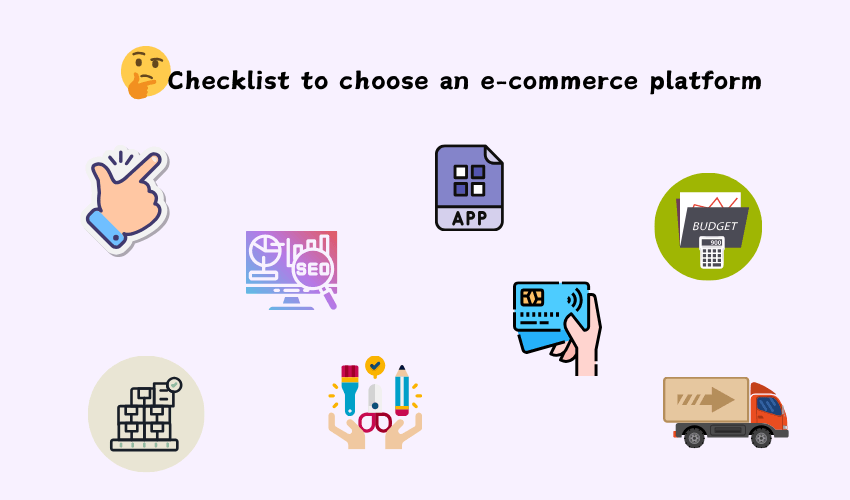
🔍Ease of Use & Daily management
Choose a platform you can actually manage. The interface should be intuitive, easy to learn, and efficient for daily operations—adding products, editing pages, tracking orders, and running campaigns. If your workflow includes dropshipping or product testing, connecting with automation tools like Flowpallet can significantly reduce manual work.
✨Storefront design & Customization
Your storefront is your brand's first impression. Look for platforms with flexible templates, drag-and-drop editors, mobile-optimized layouts, and enough customization freedom to match your branding without requiring a developer for every small update.
💴Total cost & Long-term budget
Cost isn't just the monthly subscription. Consider transaction fees, payment processing fees, app/plugin costs, themes, and potential development expenses. A platform that looks cheap at the start may become expensive as you grow, so evaluate both short-term and long-term spending.
🚪Product & Inventory management
Your platform should streamline essential tasks, from handling variants and inventory to managing SKUs and bulk data. For fast-paced or dropshipping models, automation is key—tools like Flowpallet can automate workflows to save time and enhance accuracy.
💳Payment options & Checkout experience
Your checkout experience directly influences conversion rates. Ensure the platform supports major payment gateways, multiple currencies, digital wallets, and smooth mobile checkout. Reduced friction often means higher sales.
📦Shipping, Fulfillment & Automation
Efficient fulfillment is crucial. Look for shipping integrations, real-time rates, label printing, and built-in automations. If you rely on third-party suppliers or POD, make sure the platform connects easily with your fulfillment tools—or that you can integrate solutions like Flowpallet's Auto fulfillment to automate sourcing, order syncing, delivery tracking…
Learn more about how to start a dropshipping business.
🔝Marketing, SEO & Conversion tools
Traffic and conversions don't happen by accident. Your platform should offer strong SEO settings, fast page loading, customizable meta fields, built-in analytics, discount tools, email marketing integrations, and abandoned-cart recovery. These features help you grow without relying entirely on paid ads.
📱App ecosystem & Third-party integrations
A rich app ecosystem is what lets your store evolve. Check whether the platform supports integrations with CRM systems, email platforms, marketplaces, social channels, and automation tools. A platform with a strong marketplace gives you more room to scale and adapt.
Focusing on these essentials ensures you choose a platform that fits your needs now and continues to support your growth over time.
Part 2: E-commerce platform types
Second, you should understand the different types of e-commerce platforms, helping you narrow down your choices on how to choose an e-commerce platform quickly. Here is a table you can refer to:
| Type | Description | Best for |
|---|---|---|
| Hosted e-commerce platforms (e.g., Shopify, BigCommerce) | Fully hosted, all-in-one systems with built-in security, hosting, apps, and support | (1)Beginners; (2)Small to medium-sized stores; (3)Brands that want fast setup with minimal technical work; (4)Businesses seeking all-in-one convenience |
| Self-hosted platforms (e.g., WooCommerce, Magento) | Installed on your own server; highly customizable, but requires more technical management | (1)Users with technical skills or developer resources; (2)Stores needing deep customization; (3)Businesses that want full control over hosting; (4)Brands planning custom or complex e-commerce features |
| Website builders with e-commerce add-ons (e.g., Wix, Squarespace) | Visual website builders that offer e-commerce extensions | (1)Content-driven businesses; (2)Small stores with limited product ranges; (3)Brands prioritizing aesthetics and simplicity over heavy functionality |
In the end, no single platform type is perfect for everyone. Hosted solutions offer convenience and speed, self-hosted platforms provide full customization, and website builders suit businesses that value simplicity.
The key to choosing the right e-commerce platform is choosing the type that aligns with your resources, growth plans, and how much control you want over the technical side of your store.
Part 3: Top e-commerce platforms compared
Maybe you wanna the comparison of the common and top e-commerce platforms:
| Platform | Features | Best for |
|---|---|---|
| Shopify | Extremely beginner-friendly; Large app ecosystem; Great for dropshipping and POD; Monthly fees + transaction fees | Most small-to-medium-sized ecommerce businesses want fast scalability |
| WooCommerce | Free plugin for WordPress; Highly customizable; Requires hosting and more technical setup | Content-heavy sites and businesses wanting custom control |
| BigCommerce | Built for scalability; Strong built-in SEO; More complex than Shopify | Growing brands and larger catalogs |
| Wix | Beautiful templates; Easy to use; Limited advanced e-commerce features | Small brands, creators, and simple stores |
| Squarespace | Excellent design; Strong content tools; Limited ecommerce depth compared to Shopify | Artists, service providers, and small product lines |
Choose the one meeting your needs~
Part 4: Conclusion
Choosing an e-commerce platform doesn't need to be overwhelming. Start by defining what matters most—design freedom, budget, automation, or scalability—and compare platforms based on those priorities.
And if you're building a dropshipping or product-testing store, solutions like Flowpallet can make your workflow smoother, no matter which platform you choose.
