'/%3e%3cpath%20d='M59.9558%200H51.6287C51.6287%200%2045.5566%2034.1414%2045.7996%2039.9704C48.4659%20103.923%20122.41%2090.4886%20159.049%2075.7773L159.882%2071.6137C72.4464%20100.759%2053.2939%2059.9557%2054.1268%2039.9704C54.7163%2025.8265%2059.9558%200%2059.9558%200Z'%20fill='url(%23paint1_linear_658_5274)'/%3e%3cpath%20d='M180.7%2050.7959L180.845%2049.8037C184.282%2054.4129%20189.53%2057.458%20195.688%2057.458C206.726%2057.458%20217.339%2046.0121%20217.339%2034.9746C217.339%2023.9371%20211.722%2015.8223%20200.685%2015.8223C195.356%2015.8223%20189.544%2018.1027%20184.957%2021.7031L185.696%2016.6543H177.369L168.209%2075.7773H176.536L180.7%2050.7959ZM194.023%2049.9629C183.198%2049.1302%20183.198%2041.6353%20183.198%2037.4717C183.198%2028.3123%20190.455%2023.3157%20197.354%2023.3154C204.252%2023.3154%20208.18%2027.6155%20208.18%2034.9736C208.18%2044.1334%20200.922%2049.9627%20194.023%2049.9629Z'%20fill='%23FBFBFB'/%3e%3cpath%20d='M221.503%2050.7954C226.722%2063.8433%20244.819%2055.7917%20248.982%2050.7954C247.65%2056.7908%20255.088%2057.1796%20258.974%2056.6245L259.807%2049.1304C258.697%2049.1304%20256.476%2048.6308%20256.476%2046.6323C256.476%2044.1342%20260.451%2031.2297%20258.974%2025.814C253.978%207.49469%20228.164%2015.8221%20225.666%2024.9819L231.495%2028.312C242.32%2016.6545%20253.146%2024.9814%20249.815%2031.6431C239.823%2029.1449%20214.842%2034.1413%20221.503%2050.7954ZM248.982%2038.3052C250.648%2045.7997%20233.994%2056.6248%20229.83%2046.6323C227.054%2039.9706%20241.488%2037.4725%20248.982%2038.3052Z'%20fill='%23FBFBFB'/%3e%3cdefs%3e%3clinearGradient%20id='paint0_linear_658_5274'%20x1='333.92'%20y1='70.601'%20x2='188.194'%20y2='70.601'%20gradientUnits='userSpaceOnUse'%3e%3cstop%20stop-color='%23EB5455'/%3e%3cstop%20offset='0.0001'%20stop-color='%23EF733E'/%3e%3cstop%20offset='1'%20stop-color='%23FFD461'/%3e%3c/linearGradient%3e%3clinearGradient%20id='paint1_linear_658_5274'%20x1='139.897'%20y1='83.2717'%20x2='53.2939'%20y2='3.33085'%20gradientUnits='userSpaceOnUse'%3e%3cstop%20stop-color='%23FFD461'/%3e%3cstop%20offset='0.9999'%20stop-color='%23EF733E'/%3e%3c/linearGradient%3e%3c/defs%3e%3c/svg%3e)


Where to Source Products to Sell Online [Step-by-Step]
FlowpalletAurora ShawJun. 11, 2026

Choosing the right products is one of the most decisive factors in building a successful online business. Whether you are launching a niche e-commerce store, expanding an existing catalog, or testing new ideas, product sourcing directly impacts your margins, branding, and long-term scalability.
With countless sourcing channels available today, the real challenge lies in understanding how each method works and selecting the one that fits your business model. This guide walks you through the fundamentals of product sourcing and provides practical steps to help you source profitable products to sell online.
1. What is product sourcing & key factors to consider
Products sourcing is the process of finding, evaluating, and purchasing products you'll sell through your online store or marketplace. It can involve buying in bulk, working with factories, partnering with dropshipping suppliers, ordering custom merchandise, or even reselling retail items.
Before you choose a sourcing channel, consider the following key points:
- Product quality: Poor quality leads to returns, negative reviews, and higher costs.
- Pricing & profit margins: Evaluate the total cost—including manufacturing, packaging, shipping, and platform fees.
- Supplier reliability: Timely communication, consistent stock levels, and stable production capacity are essential.
- Shipping times: Faster delivery improves conversion rates and customer satisfaction.
- Scalability: Your supplier should be able to grow with you as sales increase.
2. Different product sourcing options
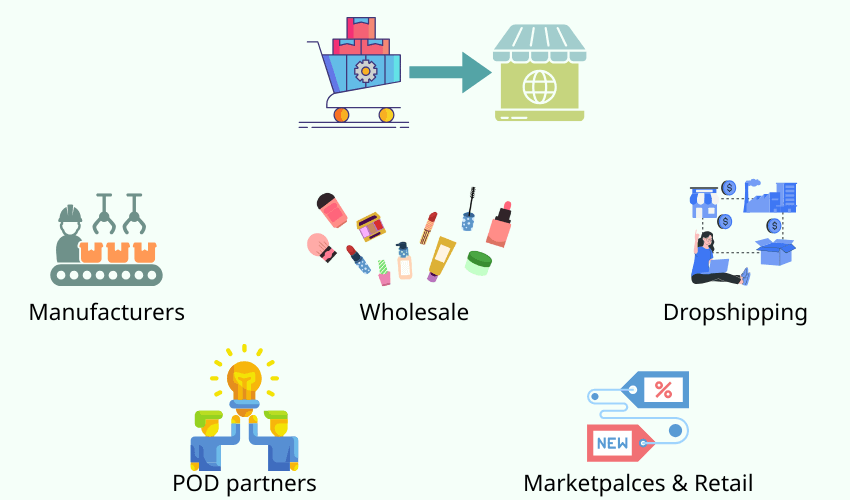
When sourcing products to sell online, there's no one-size-fits-all approach. Each sourcing model comes with its own advantages, challenges, and cost structure. See a table and details below:
| Sourcing method | Upfront cost | Control over product | Scalability | Risk level | Best for |
|---|---|---|---|---|---|
| Manufacturers | High | Very high | Excellent | Moderate | Brands needing custom products, long-term scaling |
| Wholesale suppliers | Medium-high | Medium | Very good | Moderate | Sellers wanting branded goods or stable inventory |
| Dropshipping suppliers | Very low | Low | Good (with automation) | Low | Beginners, low-budget sellers, and rapid product testing |
| POD partners | Very low | Medium (design-focused) | Moderate | Low | Creative, influencers, design-led brands |
| Marketplaces & retail arbitrage | Low | Very low | Low | Low-medium | Beginners, opportunistic resellers, side-sellers |
Sourcing with manufacturers
Working directly with a factory gives you the most control. You can decide exactly how the product is made, what it looks like, and what it costs in the long run. You can ask for custom designs, your own packaging, better materials, and specific quality rules.
The downside is that it takes more money and effort at the start. You'll have to handle samples, contracts, checking the factory's credentials, and arranging shipping and customs.
Sourcing with wholesale suppliers
Wholesale suppliers are a medium for sellers who want ready-made products without making them themselves. You buy items in bulk at lower prices, which is great for reselling established brands or popular products.
The biggest perk is speed—items are ready to ship, so you skip the wait time of manufacturing. The flip side is that since many sellers have the same products, it's hard to stand out. Your profits can also be less predictable due to competition and brand rules.
If you wanna find wholesalers in dropshipping, please check drop shipping suppliers for wholesalers.
Sourcing with dropshipping suppliers
Dropshipping is one of the most flexible and beginner-friendly sourcing options available today. Instead of holding inventory yourself, you partner with a supplier who ships orders directly to your customers. This means zero upfront inventory costs, minimal risk, and the ability to test dozens of products rapidly.
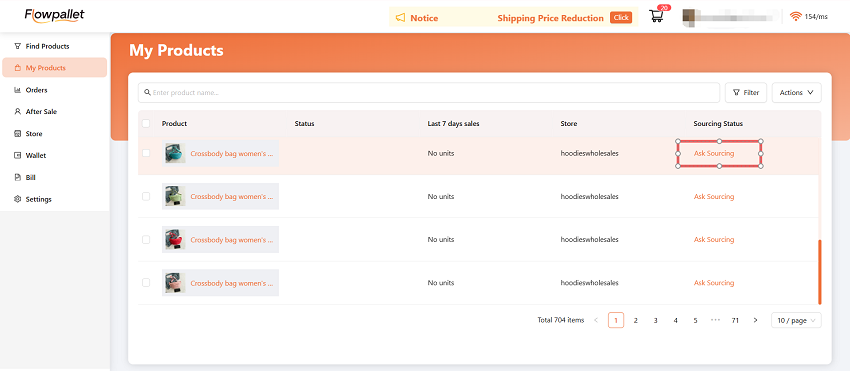
Because dropshipping eliminates warehousing and bulk purchasing, sellers can focus on product research, marketing, and customer experience. Modern automation tools such as Flowpallet help quickly source needed items, sync your store orders, automate order fulfillment, and consolidate multiple suppliers inside one workflow. This allows sellers to operate more efficiently and reduce the typical manual workload associated with dropshipping.
Sourcing with print-on-demand partners
Print-on-demand (POD) lets you sell custom-designed items—shirts, mugs, wall art—without buying inventory. Each product is produced after a customer places an order.
Sourcing with marketplaces & retail arbitrage
Retail arbitrage means purchasing discounted items from retailers (online or offline) and reselling them at a higher price. Online marketplaces such as Amazon, Walmart, and liquidation sites also offer opportunities to source limited-quantity or clearance items.
3. How to source products to sell online
Follow these steps to ensure you're sourcing profitable, high-quality products:
- Define your niche and customer profile: Understand who you're selling to and what problems your product solves.
- Research market demand: Use keyword tools, competitor analysis, and marketplace insights to validate interest and pricing potential.
- Compare sourcing methods: Choose between manufacturers, wholesale, dropshipping, POD, or arbitrage based on your budget, goals, and logistics plan.
- Evaluate suppliers thoroughly: Check product quality, shipping options, customer reviews, MOQ, and communication responsiveness.
- Order samples: Inspect quality, packaging, durability, and branding opportunities before committing.
- Calculate total costs and margins: Include product costs, shipping fees, taxes, marketplace fees, packaging, and marketing expenses.
- Negotiate and build a relationship: Strong communication leads to better pricing, priority production, and long-term reliability.
Learning how to source products to sell effectively is the foundation of any successful online business. Whether you choose the way above, the right approach depends on your goals, budget, and long-term vision.
By taking time to evaluate suppliers, compare sourcing models, and use tools like Flowpallet to do dropshipping, you can build a product strategy that's both profitable and scalable.
