'/%3e%3cpath%20d='M59.9558%200H51.6287C51.6287%200%2045.5566%2034.1414%2045.7996%2039.9704C48.4659%20103.923%20122.41%2090.4886%20159.049%2075.7773L159.882%2071.6137C72.4464%20100.759%2053.2939%2059.9557%2054.1268%2039.9704C54.7163%2025.8265%2059.9558%200%2059.9558%200Z'%20fill='url(%23paint1_linear_658_5274)'/%3e%3cpath%20d='M180.7%2050.7959L180.845%2049.8037C184.282%2054.4129%20189.53%2057.458%20195.688%2057.458C206.726%2057.458%20217.339%2046.0121%20217.339%2034.9746C217.339%2023.9371%20211.722%2015.8223%20200.685%2015.8223C195.356%2015.8223%20189.544%2018.1027%20184.957%2021.7031L185.696%2016.6543H177.369L168.209%2075.7773H176.536L180.7%2050.7959ZM194.023%2049.9629C183.198%2049.1302%20183.198%2041.6353%20183.198%2037.4717C183.198%2028.3123%20190.455%2023.3157%20197.354%2023.3154C204.252%2023.3154%20208.18%2027.6155%20208.18%2034.9736C208.18%2044.1334%20200.922%2049.9627%20194.023%2049.9629Z'%20fill='%23FBFBFB'/%3e%3cpath%20d='M221.503%2050.7954C226.722%2063.8433%20244.819%2055.7917%20248.982%2050.7954C247.65%2056.7908%20255.088%2057.1796%20258.974%2056.6245L259.807%2049.1304C258.697%2049.1304%20256.476%2048.6308%20256.476%2046.6323C256.476%2044.1342%20260.451%2031.2297%20258.974%2025.814C253.978%207.49469%20228.164%2015.8221%20225.666%2024.9819L231.495%2028.312C242.32%2016.6545%20253.146%2024.9814%20249.815%2031.6431C239.823%2029.1449%20214.842%2034.1413%20221.503%2050.7954ZM248.982%2038.3052C250.648%2045.7997%20233.994%2056.6248%20229.83%2046.6323C227.054%2039.9706%20241.488%2037.4725%20248.982%2038.3052Z'%20fill='%23FBFBFB'/%3e%3cdefs%3e%3clinearGradient%20id='paint0_linear_658_5274'%20x1='333.92'%20y1='70.601'%20x2='188.194'%20y2='70.601'%20gradientUnits='userSpaceOnUse'%3e%3cstop%20stop-color='%23EB5455'/%3e%3cstop%20offset='0.0001'%20stop-color='%23EF733E'/%3e%3cstop%20offset='1'%20stop-color='%23FFD461'/%3e%3c/linearGradient%3e%3clinearGradient%20id='paint1_linear_658_5274'%20x1='139.897'%20y1='83.2717'%20x2='53.2939'%20y2='3.33085'%20gradientUnits='userSpaceOnUse'%3e%3cstop%20stop-color='%23FFD461'/%3e%3cstop%20offset='0.9999'%20stop-color='%23EF733E'/%3e%3c/linearGradient%3e%3c/defs%3e%3c/svg%3e)


Print On Demand: What It Is & Pros and Cons
FlowpalletAurora ShawJun. 12, 2026

In recent years, print-on-demand has become one of the easiest ways to start an online business. You don't need a warehouse, a large startup budget, or even packing experience. With the right platform and a few creative ideas, almost anyone can launch a store selling custom products online.
Today, print-on-demand items are everywhere - from custom T-shirts and hoodies to mugs, posters, tote bags, and phone cases. It's a popular choice among creators, side hustlers, and ecommerce newcomers alike, largely because it eliminates one of the biggest headaches in online retail: managing inventory.
But what is print on demand, and how does it work? Follow us, we'll walk you through everything.
1. What is print on demand?
Print on demand (POD) is an e-commerce model where items are only produced once a customer places an order.
Rather than purchasing stock in bulk, sellers simply upload their designs to a POD supplier. From there, the supplier takes care of everything - printing, packaging, and shipping - automatically.
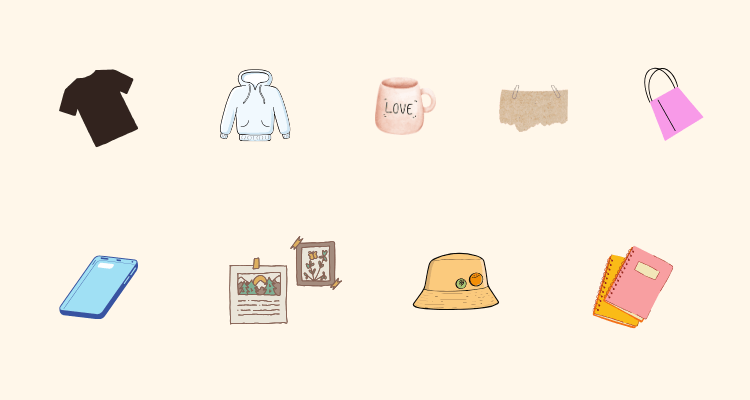
In short, you can sell personalized products online without ever touching inventory yourself. Popular print-on-demand products include:
- T-shirts
- Hoodies
- Mugs
- Stickers
- Tote bags
- Phone cases
- Posters
- Hats
- Notebooks
POD is widely regarded as a form of dropshipping, since the supplier ships orders directly to customers. The key distinction, however, is that POD products carry your own custom designs or branding.
For instance, rather than reselling a plain backpack from a supplier, you could offer a hoodie featuring your original artwork or a catchy slogan. This is why POD is particularly appealing to:
- Designers
- Artists
- Influencers
- Small brands
- Content creators
- E-commerce beginners
Read more: POD dropshipping
2. How print-on-demand works
The print-on-demand process is surprisingly simple. Most platforms automate nearly everything behind the scenes. Here is how it usually works:
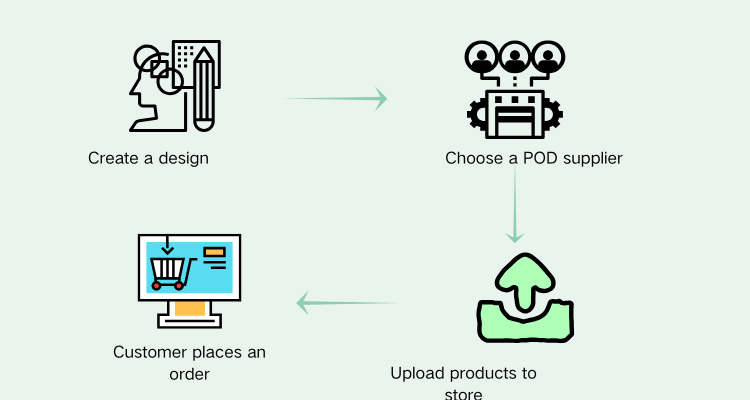
1️⃣Create a design
First, you create a design for your products. This could be:
- Typography quotes
- Minimal graphics
- Anime-inspired art
- Pet illustrations
- Fitness slogans
- Meme designs
- Niche community artwork
You don't need to be a professional designer. Many beginners use tools like Canva, Adobe, Figma, and so on to create simple but attractive designs.
2️⃣Choose a print-on-demand supplier
Next, you connect your store to a POD supplier. Popular print-on-demand companies include:
- Printful
- Printify
- Gelato
These suppliers provide blank products and printing services. Or you can choose a POD dropshipping platform like Flowpallet or CJ dropshipping.
3️⃣Upload products to your store
After uploading your designs, the platform generates product mockups automatically. You can then list the products on e-commerce platforms like:
- Shopify
- WooCommerce
- Etsy
Then you price products, descriptions, and branding.
Learn how to add products to Shopify.
4️⃣Customer places an order
When someone buys a product from your store:
- The order is automatically sent to the POD supplier
- The supplier prints the design
- The product is packaged
- The order is shipped directly to the customer
You never have to touch the inventory yourself. That's why many people see print-on-demand as one of the easiest e-commerce business models to start.
3. Advantages and disadvantages of print-on-demand
Like any business model, print-on-demand has both benefits and drawbacks. See here:
| Advantages | Disadvantages |
|---|---|
| Low startup costs - No need to buy inventory upfront | Lower profit margins - Individual printing costs are usually higher |
| No inventory management - Suppliers handle storage and shipping | High competition - Many sellers enter popular niches |
| Beginner-friendly - Easy to launch with minimal experience | Slower shipping times - Products are printed after orders are placed |
| Creative freedom - Sell unique custom designs and branded products | Limited quality control - Product quality depends on suppliers |
| Low business risk - Easier to test products without large investments | Harder to scale quickly - Managing large product catalogs can become challenging |
| Flexible product selection - Easily add or remove products from your store | Design dependency - Weak or generic designs usually perform poorly |
Hope this table can help you know POD more.
4. Print on demand vs dropshipping
Print on demand and dropshipping are similar, but they are not exactly the same. Both business models require little upfront investment, avoid inventory storage, use third-party suppliers, and allow online selling from home.
However, there are some major differences.
| Feature | Print on demand | Traditional dropshipping |
|---|---|---|
| Products | Customized | Usually generic |
| Branding | Stronger branding potential | Limited branding |
| Product creation | Your own designs | Supplier products |
| Competition | Design-based competition | Product-based competition |
| Shipping time | Often slower | Sometimes faster |
| Inventory | No | You can choose 3PL |
Traditional dropshipping focuses on reselling existing products, while print-on-demand focuses more on customization and branding. For long-term brand building, many e-commerce sellers prefer POD because unique designs are harder to copy.
5. How to start a print-on-demand business
Starting a POD business is relatively simple, but success still requires strategy and consistency.
Step 1: Choose a niche
Instead of targeting everyone, focus on a specific audience. Popular POD niches include:
- Pets
- Fitness
- Gaming
- Coffee lovers
- Teachers
- Anime fans
- Outdoor lifestyle
- Funny quotes
Niche-focused stores usually perform better than general stores.
Step 2: Create unique designs
Strong designs are one of the biggest success factors in POD.
Avoid copying trends directly. Instead, create designs that connect emotionally with a specific audience.
Simple designs often outperform overly complicated ones.
Step 3: Pick the right e-commerce platform
Most beginners choose: Shopify for simplicity; WooCommerce for flexibility; Etsy for marketplace traffic…
Your platform choice depends on your budget and growth goals.
Step 4: Connect a POD supplier
Once your store is ready, connect a print-on-demand supplier and import products. Many suppliers integrate directly with e-commerce platforms, making automation easy.
You can also use fulfillment and automation tools like Flowpallet to streamline order management, supplier connections, and e-commerce workflows more efficiently as your business grows.
It can also provide you with the POD option. Please chat with customer service. Then POD on it > Connect your store with Flowpallet > Pick and pack > Ship to the customer.
Step 5: Market your store
Even great products won't sell without traffic. Common POD marketing channels include:
- TikTok
- SEO blogs
- Influencer marketing
- Facebook ads
Short-form content works especially well for visual products like apparel and accessories.
6. Conclusion
Print on demand is one of the most beginner-friendly ways to break into online business today. It pairs low startup costs with genuine creative freedom - making it a compelling option for entrepreneurs, artists, and side hustlers of all kinds.
Yes, POD comes with its challenges. Competition can be tough, and profit margins tend to be slimmer than traditional retail. But it also offers a straightforward, low-risk way to test product ideas and build a brand from scratch - all without the hassle of managing inventory.
If you're after an e-commerce model that's easy to start, light on risk, and leaves room for creativity, print on demand is a solid place to begin.
