


How to Research A Niche Market: Full Guide
FlowpalletAurora ShawOct. 28, 2026

I wanna do POD, but I'm unsure what is important when researching a niche market. Any suggestions?-reddit.com
Like this user, niche market research means gathering enough evidence to decide whether a narrow market deserves a controlled test. You need to look at demand, buyers, competition, profit potential, and fulfillment before spending much money.
None of those pieces proves a business will work on its own. Together, they show whether the opportunity is worth investigating further.
This guide is for founders, small business owners, and e-commerce sellers who are comparing possible markets. Keep reading~
What is niche market research, and why does it matter?
Niche market research examines a specific group of customers and the problem they are trying to solve. A useful study goes beyond market size. It looks at what people already use, what frustrates them, what they are willing to pay for, and whether you can deliver something they value.
Consider a simple example: ergonomic desk accessories for remote workers with small home offices. The broad label tells you what the products are. It does not tell you whether those workers want another laptop stand, whether they would pay more for a foldable design, or whether returns would erase the margin.
That difference matters because interest can be misleading. A popular topic may have plenty of readers and few buyers. A smaller audience may have a costly, recurring problem and a clear reason to switch providers. Niche market research separates attention from a viable opportunity.
It also helps you decide when to stop. Not every niche is worth entering, and that is a useful result. A clear "no" can save more time than a vague "maybe."
Before you start: define the decision and evidence standard
Define the decision first, then collect evidence. Don't ask "Should I start a business?" Ask "Should I test this product with a small group of buyers?"
| Decision | Evidence to collect | What to record | Warning sign |
|---|---|---|---|
| Does a real problem exist? | Customer interviews, reviews, community questions | Exact customer wording, frequency, current alternatives | All complaints come from one person |
| Will people pay? | Price comparisons, waitlists, presales, trials | Price tested, buying conditions, actual conversion | Interest vanishes once a price appears |
| Can the offer stand out? | Competitor and substitute analysis | Positioning, customer complaints, switching reasons | The only difference is a lower price |
| Can the numbers work? | Cost estimates, scenario model | Unit costs, margins, acquisition assumptions, cash needs | Profit depends on best-case costs |
| Can delivery hold up? | Supplier terms, fulfillment checks | MOQ, lead time, quality control, returns process | Capacity is assumed, not confirmed |
For every source, note the date, region, sample size, and method where available. Sources that seem to conflict often just differ in region (US vs. Europe) or measure (search interest vs. completed purchases).
How to do niche market research in 7 steps
The seven steps below work as a sequence, but you may revisit an earlier step when new evidence changes the picture. That is normal. A market that looks promising at step two can fail the economics test at step five.
Step 1: Identify your interests and potential markets
Shortlist 2-4 niches. Interest in a subject helps you ask better questions, but it isn't demand. Compare each niche on:
- Your experience with the problem
- Skills and resources needed
- Access to customers
- Regulatory or operational limits
- Delivery requirements
- Cost of reaching an audience
Experience (say, in dental administration) is useful, but test it anyway.

Step 2: Analyze market demand
Search volume, community discussion, listings, reviews, waitlists, and sales data each answer a different question. Search shows people want information. Reviews show they compare offers. A waitlist shows interest. Only purchases, deposits, or repeat use show buying intent. One signal doesn't prove another.
Record the customers' own words: a nuisance, a deadline, a failed workaround, or a hit to income. Record negative evidence too, such as few listings, repeated complaints about the category, or low price sensitivity. Contradictions usually point to something worth digging into.
Step 3: Understand your target audience
A customer profile becomes useful only when it explains a buying decision. Age and location are easy to list and often tell you very little about why someone will choose an alternative.
Focus on five things:
- The problem the customer is trying to solve
- What they use now
- What triggers a search for something better
- What makes switching feel risky or expensive
- What they expect to pay and what they need in return
Interviews and reviews are especially useful for this step. Ask people about the last time they dealt with the problem. What did they try? What did it cost them? What nearly made them switch? What stopped them?
Avoid leading questions such as "Wouldn't you buy a cheaper version?" Ask about past behavior and current trade-offs instead. People are usually better at describing what they did than predicting exactly what they will buy later.
One or two enthusiastic comments are not a customer segment. Look for patterns across different sources and note who is missing from the sample.
Step 4: Research your competitors
List direct competitors, indirect competitors, and workarounds (a spreadsheet, an agency, a manual process, or living with the problem). Compare from the buyer's side:
- Promised outcome
- Ease of understanding and buying
- Total cost, including setup, shipping, and fees
- Praise and complaints
- Reasons to stay
- Reasons to switch
A crowded market may mean proven demand. A quiet one may mean no buyers. Ask which need is underserved and what evidence says it matters.
Step 5: Evaluate profit potential
Build a unit economics model before you get attached to an idea. Inputs: price, variable costs, acquisition cost, fixed costs, and cash tied up in inventory or delivery.
- Contribution margin per unit = selling price − variable cost per unit
- Break-even units = fixed costs ÷ contribution margin per unit
Run scenarios: higher supplier costs, low conversion, high returns. The aim is to see which assumptions matter most. Watch cash flow too. Paying suppliers early or sitting on unsold stock can sink an order that's profitable on paper. Use current quotes, note where each figure came from, and label guesses as guesses.
Step 6: Evaluate supplier availability and fulfillment
Fulfillment shapes the offer, the customer experience, and the economics. Ask suppliers about:
- MOQ and lead times
- Quality control
- Customization
- Packaging and labeling
- Shipping destinations and restrictions
- Returns
- Peak capacity
- Backup supply
Then map those answers to your actual order profile. A supplier that works for a low-volume test may not work when demand grows. A fulfillment setup that looks efficient for a standard product may become expensive when items are fragile, bulky, regulated, or frequently returned.
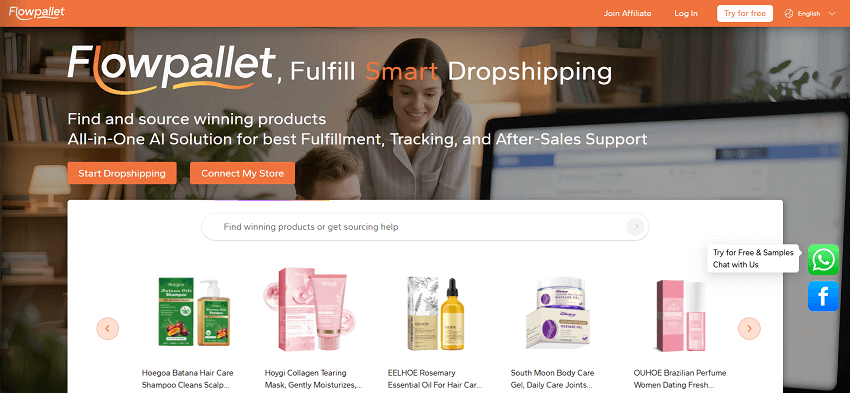
Flowpallet enters the conversation here. If it is on your fulfillment shortlist, compare its current services and terms against the same requirements rather than starting with a feature list. Confirm the service scope, fees, delivery coverage, capacity limits, return process, and contract terms in writing. A platform is only a strong fit when it solves a real constraint in your operation.
Step 7: Validate your niche before launching
Choose the cheapest test that gives useful evidence, and set the success measure first. Page views don't show willingness to pay, and a large following doesn't test fulfillment.
| Test | Shows | Doesn't show |
|---|---|---|
| Customer interviews | Repeated problems, alternatives, buying barriers | Whether enough people will pay |
| Landing page/waitlist | Whether the message draws interest | Whether visitors will buy |
| Small paid traffic test | Which promise or audience responds | Long-term demand and retention |
| Presale/small pilot | Whether some customers commit before scale | Whether the model works at volume |
| Limited inventory launch | Real orders, returns, support, fulfillment | Results beyond the test conditions |
Then decide:
- Go: the evidence supports the next stage, even if some risks remain.
- Adjust: one part of the offer or audience needs a different test.
- Stop: the core assumptions fail, or the risks cost too much to resolve.
Write down what would change your mind, so a small win isn't mistaken for proof of the whole business. Learn more about top dropshipping products.
Common niche market research mistakes to avoid
One common mistake is treating interest as intent. A growing search trend can be useful context, but it does not prove that people will pay.
Other problems include:
- Defining the customer so broadly that every piece of evidence fits.
- Looking only at direct competitors and ignoring existing workarounds.
- Counting revenue while ignoring acquisition, returns, shipping, and cash costs.
- Assuming a supplier can scale because it can fill the first order.
- Treating a busy landing page as proof that the business model works.
- Using undated data or failing to check whether it applies to the target market.
- Continuing the research long after the evidence has clearly failed the go criteria.
Niche market research should become more focused as it progresses. If the research keeps broadening instead of narrowing to a decision, revisit the research brief.
Bottom Line
Niche market research works best as a chain of evidence rather than a collection of encouraging signals. Shortlist markets you can understand and serve, test demand against real buying behavior, study the alternatives, run the numbers, check fulfillment, and validate with a controlled test.
Use the seven steps and the research brief as a working checklist. Bring the same requirements to every supplier conversation, including Flowpallet, and compare providers against your actual order profile rather than a generic feature list. A clear decision, even a cautious one, is the real output of good research.
