'/%3e%3cpath%20d='M59.9558%200H51.6287C51.6287%200%2045.5566%2034.1414%2045.7996%2039.9704C48.4659%20103.923%20122.41%2090.4886%20159.049%2075.7773L159.882%2071.6137C72.4464%20100.759%2053.2939%2059.9557%2054.1268%2039.9704C54.7163%2025.8265%2059.9558%200%2059.9558%200Z'%20fill='url(%23paint1_linear_658_5274)'/%3e%3cpath%20d='M180.7%2050.7959L180.845%2049.8037C184.282%2054.4129%20189.53%2057.458%20195.688%2057.458C206.726%2057.458%20217.339%2046.0121%20217.339%2034.9746C217.339%2023.9371%20211.722%2015.8223%20200.685%2015.8223C195.356%2015.8223%20189.544%2018.1027%20184.957%2021.7031L185.696%2016.6543H177.369L168.209%2075.7773H176.536L180.7%2050.7959ZM194.023%2049.9629C183.198%2049.1302%20183.198%2041.6353%20183.198%2037.4717C183.198%2028.3123%20190.455%2023.3157%20197.354%2023.3154C204.252%2023.3154%20208.18%2027.6155%20208.18%2034.9736C208.18%2044.1334%20200.922%2049.9627%20194.023%2049.9629Z'%20fill='%23FBFBFB'/%3e%3cpath%20d='M221.503%2050.7954C226.722%2063.8433%20244.819%2055.7917%20248.982%2050.7954C247.65%2056.7908%20255.088%2057.1796%20258.974%2056.6245L259.807%2049.1304C258.697%2049.1304%20256.476%2048.6308%20256.476%2046.6323C256.476%2044.1342%20260.451%2031.2297%20258.974%2025.814C253.978%207.49469%20228.164%2015.8221%20225.666%2024.9819L231.495%2028.312C242.32%2016.6545%20253.146%2024.9814%20249.815%2031.6431C239.823%2029.1449%20214.842%2034.1413%20221.503%2050.7954ZM248.982%2038.3052C250.648%2045.7997%20233.994%2056.6248%20229.83%2046.6323C227.054%2039.9706%20241.488%2037.4725%20248.982%2038.3052Z'%20fill='%23FBFBFB'/%3e%3cdefs%3e%3clinearGradient%20id='paint0_linear_658_5274'%20x1='333.92'%20y1='70.601'%20x2='188.194'%20y2='70.601'%20gradientUnits='userSpaceOnUse'%3e%3cstop%20stop-color='%23EB5455'/%3e%3cstop%20offset='0.0001'%20stop-color='%23EF733E'/%3e%3cstop%20offset='1'%20stop-color='%23FFD461'/%3e%3c/linearGradient%3e%3clinearGradient%20id='paint1_linear_658_5274'%20x1='139.897'%20y1='83.2717'%20x2='53.2939'%20y2='3.33085'%20gradientUnits='userSpaceOnUse'%3e%3cstop%20stop-color='%23FFD461'/%3e%3cstop%20offset='0.9999'%20stop-color='%23EF733E'/%3e%3c/linearGradient%3e%3c/defs%3e%3c/svg%3e)


Dropshipping Product Research Tool - Get Started Here
FlowpalletAurora ShawJun. 15, 2026

If you are running an e-commerce or starting a dropshipping business, one question comes up again and again: How do I know this product will sell?
What tools do you guys use for product research? I'm looking to get into FBA, and I want to have everything planned out before I start. -reddit.com
That's where product research tools come in. They promise data, trends, and insights that help you avoid guesswork. But with so many tools on the market - each claiming to uncover "winning products" or "best items to dropship" - it can be hard to decide which one is actually right for you.
The truth is, there is no universal best tool. The right choice depends on your business model, budget, and growth stage. In this guide, we'll break down what product research tools really do, the main types, and how to choose one that fits your needs.
What is a product research tool?
A product research tool is software designed to help sellers discover and evaluate products before investing time and money into them. Instead of relying purely on instinct, these tools provide data such as:
- Sales estimates
- Search volume trends
- Competitor performance
- Advertising insights
- Product engagement metrics
Especially for dropshipping sellers, research tools can help find products that already have market demand, so you don't have to build consumer interest from nothing.
That said, it's crucial to keep in mind that product research tools do not guarantee success. They only reveal trends and opportunities. You still need to verify profit margins, supplier dependability, and whether order fulfillment is practical.
Types of product research tools
Not all research tools work the same way. Here are the main kinds you'll encounter:
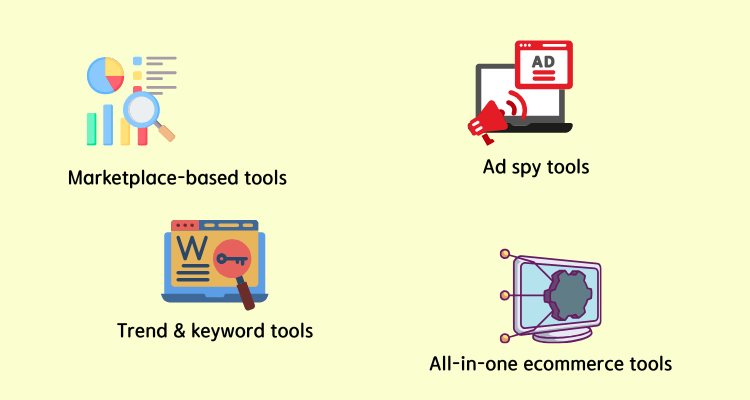
(1) Marketplace-based tools
These tools focus on large e-commerce platforms and analyze product performance within those marketplaces. They typically provide:
- Sales volume estimates
- Best-seller rankings
- Revenue projections
- Review tracking
🔑They're useful if you want to understand what's already performing well in a specific ecosystem.
(2) Ad spy tools
Ad spy tools monitor paid advertising across social media platforms. They help you:
- Find products that are currently being advertised
- Analyze ad creatives and marketing angles
- Spot fast-scaling products
🔑This is especially useful for dropshipping sellers who rely heavily on paid traffic.
(3) Trend & keyword tools
Trend tools focus on search behavior and market demand over time. They show:
- Rising or falling search volume
- Seasonal trends
- Regional demand
🔑They work best for confirming long-term demand, rather than just following short-term viral products.
(4) All-in-one ecommerce tools
These platforms combine product databases, ad analysis, keyword research, and store tracking in one dashboard.
🔑They are convenient but often have higher subscription fees. They can simplify the process for beginners, while advanced sellers may use them as part of a larger toolkit.
What to consider in a product research tool?
Picking the right product research tool isn't just about checking features—it's about finding what works best for your business. Here's what to focus on for you:
1️⃣Your business model
Dropshipping has different needs than private label or wholesale. Since you don't keep inventory, you need reliable suppliers, fast shipping, scalable order fulfillment…
A tool can show you high-demand products, but scaling is risky if you can't source them consistently.
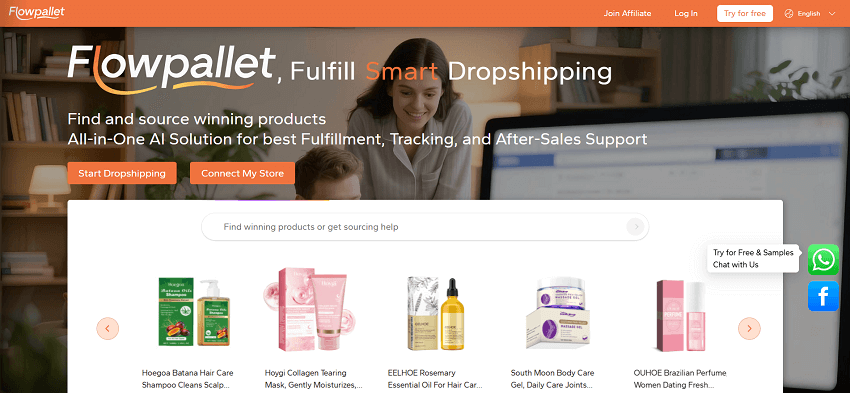
That's where operational support helps. While research tools find opportunities, a fulfillment partner like Flowpallet makes sure those products can actually be sourced, stored, picked, packed, and shipped smoothly. Good research plus reliable fulfillment keeps your business running as you grow.
2️⃣Budget
Free tools are easy to start, but limited. Paid tools give better insights but cost monthly.
Beginners usually don't need advanced features right away. As your business grows, upgrading to better data is often worth it.
3️⃣Data accuracy
No tool is 100% perfect. Stick with platforms that update often and give realistic, trusted estimates. Always double-check important data before deciding.
4️⃣Ease of use
Complicated dashboards waste time. Choose a tool that shows data clearly and lets you make fast, confident decisions.
5️⃣Scalability
Ask yourself: Will this tool still work when you get 50 or 100 orders a day?
The same goes for fulfillment. Manual work with suppliers breaks down as sales rise. Pairing your product research with dependable sourcing and fulfillment—like Flowpallet—makes sure your operations can keep up with your growth.
How to combine tools for better results
Relying on a single tool often gives you a limited view. Smart sellers combine multiple data sources. For example, you can:
- Use a trend tool to validate demand
- Use an ad spy tool to check active promotions
- Use a marketplace tool to analyze competition
Then, verify sourcing and shipping feasibility before scaling
But remember: data is only part of the product research tools. Real success comes from testing, improving your offer, and ensuring your fulfillment system can handle growth smoothly.
