


How to Reduce Returns: A Practical Guide for E-commerce
FlowpalletAurora ShawOct. 23, 2026

🗨I've been trying to improve how to handle returns, but none of them work; how can I do? -reddit.com
Quick answer: To reduce product returns, fix the causes before they reach the customer. Five things cause most of them: a listing that overpromised, an item that arrived damaged or defective, a size or compatibility mismatch, a wrong or incomplete order, and a delivery that landed too late. Fix the listing, the quality control, and the fulfillment accuracy first. Tighten the return policy last, if at all.
Why do customers return products?
Most returns come down to five reasons: the item doesn’t match the listing, it arrives damaged or defective, the size is wrong, the wrong variant ships, or it shows up too late. A simple change of mind accounts for a smaller share.
Each reason belongs to a different part of your business. A blurry product photo and a crushed carton are both returns, but different people fix them.
| Return reason | What you'll see | Where the fix is |
|---|---|---|
| Not as described | "Not what I expected" claims on one SKU, often with customer photos | Product content: photos, dimensions, materials, box contents |
| Damaged or defective | Broken, leaking, or dead-on-arrival claims on one batch or supplier | Packaging, incoming quality checks, supplier consistency |
| Wrong or incomplete order | Wrong item, wrong variant, missing accessory | Pick, pack, and dispatch accuracy |
| Fit or compatibility | "Runs small," "won't fit my model," repeat size exchanges | Sizing charts, compatibility tables, pre-purchase support |
| Late delivery | "Arrived after I needed it," or customers who gave up waiting | Dispatch speed, warehouse location, carrier choice |
NRF and Happy Returns projected $890 billion in US retail returns for 2024. Their study also found that 76% of consumers say free returns influence where they shop, and 93% of retailers call return fraud and abuse a significant problem.
So a stricter policy isn’t the answer, because shoppers reward easy returns and strict rules cost you orders. Preventing a return is also cheaper than processing one. The better move is to give customers fewer reasons to send things back.
7 ways to reduce product returns
Start with the cause your own reason codes point to. For most stores, the first three fixes move the return rate the most.
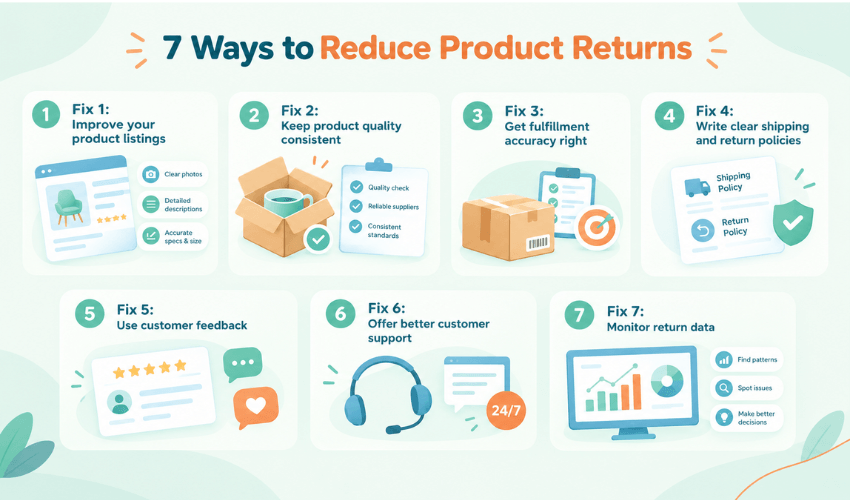
Fix 1: Improve your product listings
Customers who have to guess at color, size, or compatibility will send the product back when the guess is wrong. Fixing the listing is usually the cheapest way to cut returns.
- Use your own photos. Supplier images are often color-shifted or show a different variant.
- Add a scale reference, like a hand or a ruler in the shot.
- Give exact dimensions and weight instead of “large” or “lightweight.”
- List what’s in the box.
- Add a compatibility table for anything that fits, connects to, or powers something else.
- Say who the product isn’t for. A line like “fits cases up to 2.5 mm thick” prevents a lot of returns.
🔑Track: return rate per SKU, with “not as described” as its own reason code.
Fix 2: Keep product quality consistent
Returns that cluster on one SKU, batch, or supplier point to a quality problem.
- Sample every incoming batch, not just the first one.
- Keep a sealed reference unit to compare against.
- Record lot numbers on returns so you can show the supplier evidence.
- Set a defect threshold in advance. When a SKU crosses it, pause the listing and investigate.
- Check packaging too. A bottle that leaks in 8% of shipments is a packaging defect.
🔑Track: defect-related returns by lot, and suppliers with more than one quality incident per quarter.
Fix 3: Get fulfillment accuracy right
Wrong item, wrong variant, and missing part returns lose you the margin and the round-trip shipping.
- Scan at pick and again at pack.
- Check parcel weight at dispatch. A box 40 g under the expected weight is probably missing something.
- Audit a sample of packed orders, especially during peak season or after a warehouse change.
- Store near-identical variants (a different shade, scent, or plug type) apart from each other.
- Print the variant in plain words on the packing slip, not just the SKU code.
🔑Track: order accuracy rate = 1 − (wrong or incomplete claims ÷ orders shipped).
Fix 4: Write clear shipping and return policies
A policy sets expectations before the sale and affects how costly a return is afterward.
- State the return window in days and say what starts the clock. For cross-border orders, delivery date is clearer than order date.
- Say who pays return shipping and when the label is free.
- Spell out the condition requirements: unworn, unopened, tags attached, original packaging.
- Give the refund timeline and the refund method.
- Show shipping cut-off dates for gifts and other time-sensitive items.
- Link the policy from the cart and product page, not just the footer.
Don’t make the policy too strict. In the NRF and Happy Returns 2024 study, 76% of consumers said free returns influence where they shop.
🔑Track: checkout completion rate alongside return rate, plus how many policy questions reach support.
Fix 5: Use customer feedback
Customers tell you why they return things, but often in a review paragraph instead of a dropdown.
- Require a reason code on every return.
- Send a two-question survey after the return: why did it go back, and what would have prevented it?
- Look for repeated phrases in one- and three-star reviews, like “runs small” or “arrived leaking.”
- Log support contacts by SKU. If one product generates a fifth of your “how do I use this” questions, fix its listing.
- When you ship a fix, tell the customers who complained.
🔑Track: the share of returns with a usable reason code.
Fix 6: Offer better customer support
Good support prevents returns before the order and saves them after delivery.
- Answer sizing, fit, and compatibility questions before checkout (live chat, sizing guide, FAQ).
- Send tracking updates proactively. Customers who know about a delay are less likely to dispute the charge.
- Let support offer an exchange, replacement part, or partial credit instead of defaulting to a refund.
- Set a first-response target and check it weekly.
- For cheap damaged items, compare the cost of a return label plus restocking with the cost of a replacement. Letting the customer keep the item is often cheaper.
🔑Track: contacts per 100 orders, first-response time, and the share of contacts resolved without a return.
Fix 7: Monitor return data
A single store-wide return rate doesn’t tell you what to fix. Break it down:
| Cut by | A spike usually means |
|---|---|
| SKU or variant | Listing, photo, or quality problem on that product |
| Reason code | Where the process is failing |
| Warehouse | Pick-and-pack problem at one site |
| Carrier | Transit damage or lateness on one route |
| Customer cohort | Fit problem tied to a size, region, or repeat buyers |
| Time period | Seasonal spike, bad batch, or the effect of a recent change |
Then, you can:
- Report return rate weekly by SKU, with reason codes.
- Write down your audit threshold before you need it, such as “above baseline for two months in a row.”
- Watch net return rate (returns minus exchanges). Exchange-heavy SKUs look better on the surface than they do in margin.
- Check how long returned units take to become resellable.
How better fulfillment reduces returns
Many avoidable returns start in fulfillment: the wrong variant ships, an accessory is missing, the box arrives crushed, or the parcel shows up after the customer has given up. Five things decide how many of these you get:
- Dispatch speed: the longer an order waits, the more chances for cancellations and disputes.
- Warehouse location: stock closer to buyers travels less and arrives in better shape.
- Carrier mix: the cheapest last-mile route often comes back as damage claims or late-delivery complaints.
- Packing standards: box size, void fill, and seals.
- Supplier consistency: switching suppliers mid-season without a quality check is a common cause of defect spikes.
Where Flowpallet fits
Handling all five in-house takes several hires. Flowpallet does sourcing and fulfillment for beauty, wellness, and consumer-goods sellers, and puts most of these controls in one dashboard.
- Auto fulfillment: orders from Shopify, WooCommerce, and TikTok Shop sync automatically, with no manual forwarding or spreadsheets.
- Dispatch time: orders are usually processed within 24 to 48 hours.
- 3PL services: warehousing, multi-warehouse storage, pick-pack-ship, and custom packaging.
- Written after-sales rules: an undelivered US parcel is eligible after 45 days from dispatch, or after 60 days without tracking updates. Flowpallet refunds or resends when the carrier is at fault. Orders still in “Processing” can be cancelled with a refund in 3 to 5 business days.
Your 30-day plan
You’ll need 90 days of order and return data, a way to tag returns with reason codes, and one person who owns the return number each week. If you don’t have reason codes yet, spend week 1 on that and nothing else.
- Week 1: turn on reason codes for every return.
- Week 2: pull your top 20 SKUs by return count and rewrite their listings with dimensions, scale, compatibility, and box contents. Cut the adjectives.
- Week 3: audit pick and pack. Scan a sample of orders, weigh a sample of parcels, and note what you find.
- Week 4: rewrite your return policy in plain language, with a day count for the window, shipping rules, and a refund timeline.
- Every month after: review return rate by SKU, reason, and fulfillment node, then fix or drop whatever keeps showing up at the top.
What to expect: reason-code accuracy usually improves within two weeks. SKU-level return rates tend to follow within one to two order cycles, once the listing and packing changes are live.
Three moves that backfire
- Shortening the return window below your category’s norm. Shoppers go elsewhere, and the lost orders cost more than the return labels.
- Adding a restocking fee on low-value items. It costs more in support time and bad reviews than it brings in.
- Hiding the returns link until after purchase. A routine question turns into a chargeback, which costs far more than a refund.
Final thoughts
Most returns trace back to a few causes: unclear listings, uneven quality, fulfillment mistakes, and vague policies. You don’t have to fix them all at once. Turn on reason codes, find the SKUs that come back most, and start with those.
Check your numbers every month. If you’re sending orders through a fulfillment partner like Flowpallet, include its accuracy and dispatch data in that review too. Fewer returns mean you keep more of each sale, along with the customer.
