


Let's Follow Print-on-Demand Trends in 2026
FlowpalletAurora ShawOct. 16, 2026

The strongest print-on-demand trends in 2026 are not just about copying the latest viral design. They point to a more practical opportunity: build products for a clearly defined audience, make them feel personal, and test demand before expanding your catalog.
Print on demand (POD) lets sellers offer custom products without buying inventory upfront. But that flexibility does not guarantee sales. A trend is a starting point for research - not proof that a product will sell in your store. Use current signals to shape an idea, then validate it with your audience, product samples, and store data.
This guide covers the print-on-demand trends 2026 to watch, products worth testing, ways to spot demand early, and the steps to launch a business in 2026.
Part 1: Top POD trends in 2026: Quick summary
The print-on-demand market is evolving alongside changes in consumer preferences, design technology, and online shopping habits. In 2026, standing out requires more than simply following what's popular. Here are the key trends worth paying attention to:
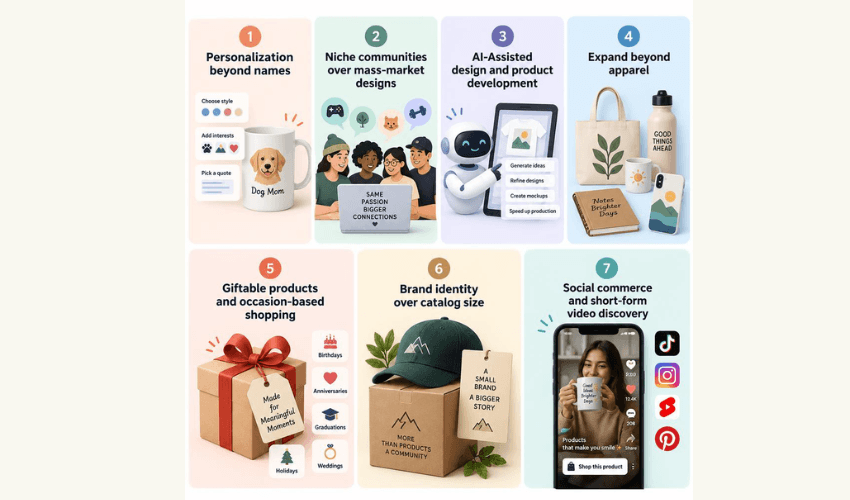
(1) Personalization beyond names
Shoppers want products that reflect their interests and identity. Build variations for hobby groups, family gifts, pet owners, and milestones.
👉 Target a specific audience, and make sure your production process can handle customization without complicating fulfillment.
(2) Niche communities over mass-market designs
Broad audiences are hard to reach and hard to stand out in. Groups like outdoor lovers, book lovers, gardeners, fitness fans, and specific pet-breed owners share interests, humor, and visual styles, which makes marketing more direct.
(3) AI-Assisted design and product development
AI is great for brainstorming, exploring styles, and early mockups. But faster designs don't guarantee more sales, and similar prompts lead to look-alike products. Also watch commercial rights, trademarks, copyrighted characters, and platform policies.
👉 Use AI for research and first drafts, then add your own creative direction. Before publishing, check image quality, print suitability, licensing, and audience relevance.
(4) Expand beyond apparel
Tote bags, drinkware, posters, phone cases, and cushions cover different buying occasions and suit gift shoppers and lifestyle niches.
👉 Add products based on demand, since a bigger catalog doesn't mean more sales. Test items that fit your existing audience first (e.g., for book lovers: totes, bookmarks, mugs, prints).
(5) Giftable products and occasion-based shopping
Birthdays, weddings, anniversaries, holidays, and graduations create steady gifting demand. Gift buyers want something thoughtful without a long search.
👉 Plan ahead for key dates and prepare designs, product pages, and promo content early. Keep evergreen products available year-round to offset seasonal swings.
(6) Brand identity over catalog size
Launching a store is easy, but building a memorable brand is harder. Consistent visuals, clear positioning, reliable customer service, and well-presented product pages set you apart. Buyers also weigh quality, delivery, pricing, and trust.
👉 Build around a specific audience or point of view, keep messaging and product photos consistent, write accurate descriptions, and make shipping and return policies clear.
(7) Social commerce and short-form video discovery
Short videos can show a design in real life, demonstrate personalization, or present a product as a gift. They don't need to be polished; a clear demo, relatable use case, or before-and-after can work better than generic promos. Views and likes don't always mean sales.
👉 Test different formats, track product-page visits and conversions, and note viewer questions to improve descriptions, designs, and future content.
Part 2: How to stay ahead of print-on-demand trends
Following trends can help generate ideas, but successful sellers need a reliable way to decide which opportunities deserve their time and money.
- Look for signals in more than one place. Compare marketplace searches, Google Trends, social posts, customer questions, and seasonal reports. A spike on one platform may not carry over to another.
- Check whether the interest is relevant to your audience. Look at who is searching, what they want to buy, and whether the trend fits your brand. Search interest alone does not show whether buyers will choose your product.
- Review competing listings. Note the products, prices, presentation, personalization options, and questions customers ask. Look for a useful gap rather than copying a popular listing.
- Test a small collection. Start with a few connected designs or products. Use original artwork and make sure every design works on the item you plan to sell.
- Measure results in your own store. Review impressions, clicks, orders, contribution margin, customer questions, and refunds. Use those signals to decide whether to refine, expand, or stop testing the idea.
- Plan for seasonality. Work backward from the occasion and your supplier's production and delivery estimates. Publish early enough for shoppers to find the listing, but confirm lead times with the supplier rather than relying on a fixed calendar rule.
- Treat trends as hypotheses. If a product gets attention but not orders, investigate the listing, price, shipping, or product fit before assuming you need more designs.
Part 3: Which print-on-demand products are worth selling in 2026?
There is no universally best POD product. The right choice depends on your audience, production costs, competition, customization options, and marketing strategy.
The following categories are worth researching and testing in 2026.
| Product category | Why it is worth considering | Potential audiences |
|---|---|---|
| T-shirts and hoodies | Flexible designs and broad use cases | Hobby communities, niche identities, lifestyle brands |
| Tote bags | Everyday utility and simple design applications | Readers, students, eco-conscious shoppers |
| Mugs and drinkware | Familiar gift options and personalization potential | Office workers, families, pet owners |
| Posters and wall art | Room for artistic styles and themed collections | Home decor enthusiasts, travelers, art lovers |
| Phone cases | Personal expression and frequent design refreshes | Style-conscious shoppers, fandom-inspired niches |
| Personalized gifts | Strong fit for specific people and occasions | Couples, families, wedding and birthday shoppers |
| Cushions and home textiles | Opportunities to match personal taste and home decor | Homeowners, renters, interior decor enthusiasts |
| Pet-themed products | Clear audience interests and emotional appeal | Dog owners, cat owners, pet gift buyers |
To choose the right products:
Rather than selecting products based on popularity alone, evaluate each idea using a few practical criteria.
1. Audience fit: Is the product relevant to the people you want to reach?
2. Profit potential: Can the selling price cover production, shipping, platform fees, marketing, and other expenses while leaving a reasonable margin?
3. Competition: Can your designs, positioning, or customer experience offer something different?
4. Production reliability: Can your supplier deliver consistent quality and reasonable shipping times?
5. Customization potential: Can you create meaningful variations without making the workflow too complicated?
For example, a seller targeting pet owners might test personalized pet mugs, tote bags, and wall art. These products serve a related audience but offer different price points and use cases. Testing them together can reveal which formats customers prefer.
The key is to validate demand before investing heavily in a large catalog.
Part 4: How to start a print-on-demand business in 2026
Starting a POD business does not require a huge product catalog. A clear audience, a focused offer, and a manageable workflow are better starting points.
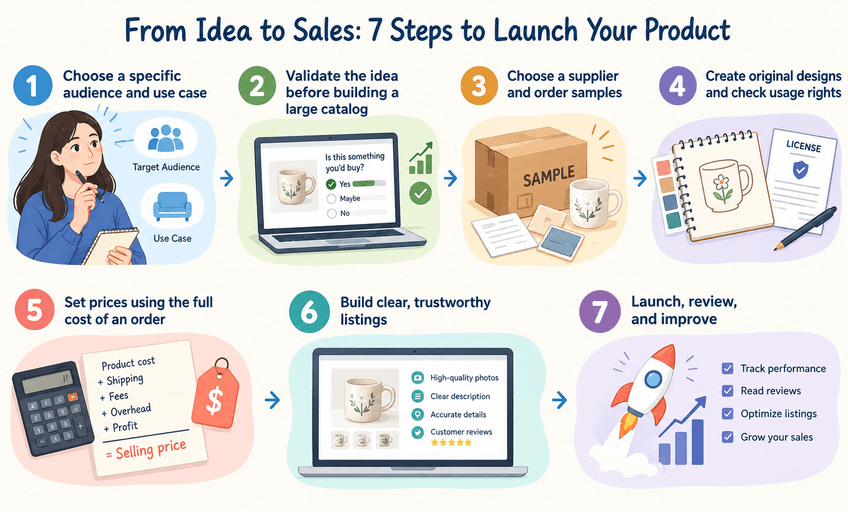
1. Choose a specific audience and use case
Decide who the store is for and why they might buy. “People who like cats” is broad; “new cat owners looking for a personalized adoption keepsake” gives you a clearer direction for both designs and product pages.
2. Validate the idea before building a large catalog
Search the relevant marketplaces and trend tools. Review the language buyers use, the kinds of products already available, and the questions they ask. Look for a product angle you can make meaningfully distinct, not just a keyword with visible activity.
3. Choose a supplier and order samples
Compare print quality, product options, shipping coverage, fulfillment estimates, customer support, and total costs. Order samples of the products you plan to sell, and check them before publishing listings.
If you want to compare providers, Flowpallet's POD service says it offers apparel, accessories, home and living products, and custom packaging. Review its current catalog, costs, delivery coverage, and sample quality against your needs before choosing a provider.
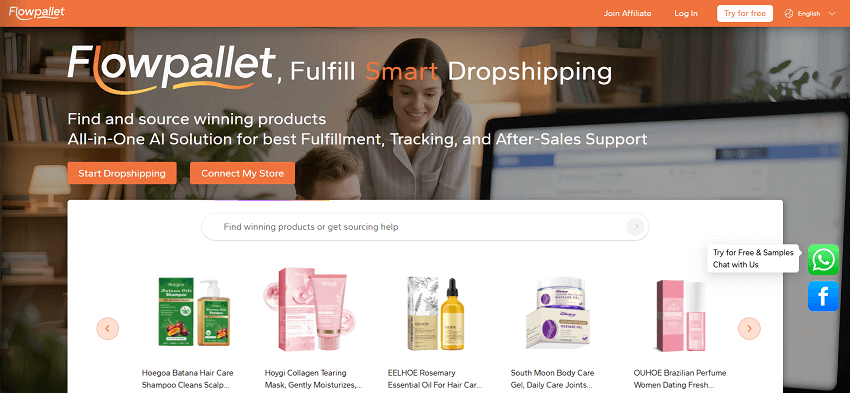
Moreover, as orders increase, manual product sourcing, supplier communication, and order processing can take up more time. This is where a more organized sourcing and fulfillment workflow becomes valuable. Flowpallet is a one-stop dropshipping platform that sellers can explore for product sourcing, fulfillment, and related supply chain services. For POD dropshipping businesses considering broader product sourcing or additional fulfillment support, it may be worth evaluating whether Flowpallet's services fit their product range, sales channels, and operational needs.
4. Create original designs and check usage rights
Use your own artwork or work you have permission to use. Avoid unlicensed characters, logos, celebrity images, song lyrics, and other protected material. A trend's popularity does not make someone else's work available for commercial use.
5. Set prices using the full cost of an order
Estimate your contribution before overhead by subtracting the product and printing cost, shipping you cover, marketplace and payment fees, advertising costs, and an allowance for refunds or replacements from the selling price. Check the numbers for each product and target market; do not assume revenue equals profit.
6. Build clear, trustworthy listings
Use original product photos or accurate mockups, a useful size guide, material details, care instructions, delivery estimates, and straightforward personalization steps. Explain what the customer will receive and how custom orders work.
For SEO, write a distinct page title and description, use descriptive product names, and organize store pages so shoppers can find related products. Add real internal links to useful collections or guides when publishing on your own site.
7. Launch, review, and improve
Promote your products in the channels where your audience spends time. Track store performance and customer feedback, then update designs, pricing, or listings based on what you learn. Keep a product only when it makes sense for your customers and your business—not simply because a trend report mentioned it.
Part 5: Final thoughts
The most useful print-on-demand trends in 2026 are not necessarily the ones that generate the most attention. Personalization, niche-focused products, AI-assisted creativity, social commerce, and stronger brand identity all offer opportunities, but none guarantees sales on its own.
The real advantage comes from understanding your audience, testing ideas before scaling, and building a reliable operation behind the designs.
Start with a focused niche, choose products that make sense for your customers, and use real performance data to guide your next move. That is a more sustainable way to build a POD business than chasing every trend that appears online.
