'/%3e%3cpath%20d='M59.9558%200H51.6287C51.6287%200%2045.5566%2034.1414%2045.7996%2039.9704C48.4659%20103.923%20122.41%2090.4886%20159.049%2075.7773L159.882%2071.6137C72.4464%20100.759%2053.2939%2059.9557%2054.1268%2039.9704C54.7163%2025.8265%2059.9558%200%2059.9558%200Z'%20fill='url(%23paint1_linear_658_5274)'/%3e%3cpath%20d='M180.7%2050.7959L180.845%2049.8037C184.282%2054.4129%20189.53%2057.458%20195.688%2057.458C206.726%2057.458%20217.339%2046.0121%20217.339%2034.9746C217.339%2023.9371%20211.722%2015.8223%20200.685%2015.8223C195.356%2015.8223%20189.544%2018.1027%20184.957%2021.7031L185.696%2016.6543H177.369L168.209%2075.7773H176.536L180.7%2050.7959ZM194.023%2049.9629C183.198%2049.1302%20183.198%2041.6353%20183.198%2037.4717C183.198%2028.3123%20190.455%2023.3157%20197.354%2023.3154C204.252%2023.3154%20208.18%2027.6155%20208.18%2034.9736C208.18%2044.1334%20200.922%2049.9627%20194.023%2049.9629Z'%20fill='%23FBFBFB'/%3e%3cpath%20d='M221.503%2050.7954C226.722%2063.8433%20244.819%2055.7917%20248.982%2050.7954C247.65%2056.7908%20255.088%2057.1796%20258.974%2056.6245L259.807%2049.1304C258.697%2049.1304%20256.476%2048.6308%20256.476%2046.6323C256.476%2044.1342%20260.451%2031.2297%20258.974%2025.814C253.978%207.49469%20228.164%2015.8221%20225.666%2024.9819L231.495%2028.312C242.32%2016.6545%20253.146%2024.9814%20249.815%2031.6431C239.823%2029.1449%20214.842%2034.1413%20221.503%2050.7954ZM248.982%2038.3052C250.648%2045.7997%20233.994%2056.6248%20229.83%2046.6323C227.054%2039.9706%20241.488%2037.4725%20248.982%2038.3052Z'%20fill='%23FBFBFB'/%3e%3cdefs%3e%3clinearGradient%20id='paint0_linear_658_5274'%20x1='333.92'%20y1='70.601'%20x2='188.194'%20y2='70.601'%20gradientUnits='userSpaceOnUse'%3e%3cstop%20stop-color='%23EB5455'/%3e%3cstop%20offset='0.0001'%20stop-color='%23EF733E'/%3e%3cstop%20offset='1'%20stop-color='%23FFD461'/%3e%3c/linearGradient%3e%3clinearGradient%20id='paint1_linear_658_5274'%20x1='139.897'%20y1='83.2717'%20x2='53.2939'%20y2='3.33085'%20gradientUnits='userSpaceOnUse'%3e%3cstop%20stop-color='%23FFD461'/%3e%3cstop%20offset='0.9999'%20stop-color='%23EF733E'/%3e%3c/linearGradient%3e%3c/defs%3e%3c/svg%3e)


What Is Private Label: Everything You Should Know
FlowpalletAurora ShawJun. 12, 2026

If you buy a product with a unique appearance, formula, or function, which is hard to find elsewhere, but is only sold through a certain brand's channels, it is very likely a private label product.
What is a private label? From cosmetics and supplements to electronics and household goods, private labeling has become one of the most popular ways for businesses to launch products quickly without building everything from scratch.
For entrepreneurs, e-commerce sellers, and growing brands, understanding how private label works can open the door to higher margins and stronger brand control.
Part 1: What is a private label?
Private label refers to products that are manufactured by a third party but sold under your own brand name. Instead of creating a product from zero, you select an existing product made by a manufacturer and customize elements such as branding, packaging, labeling, or minor specifications.
Unlike reselling branded products, private labeling allows you to position the product as uniquely yours. Customers see your logo, your packaging, and your brand story—even though the production happens behind the scenes.
Retailers often opt for private labels for convenience, allowing them to rapidly diversify their offerings using third-party manufacturers without assuming the risk themselves. Common examples include cosmetics, jewelry, electronics, and apparel.
Part 2: How does private label work?
At its core, private labeling is a collaboration between a brand owner and a third-party manufacturer. Instead of producing goods in-house, the retailer focuses on branding and sales while the manufacturer handles production.
Here's how the private label process typically works in practice:
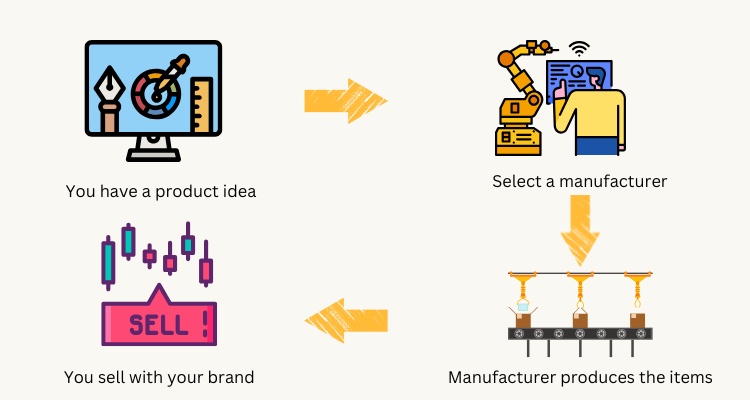
1️⃣The retailer defines a product idea: Design a new product concept or make adjustments to an existing one, such as changing ingredients, materials, features, or packaging to better match the target market.
2️⃣A third-party manufacturer is selected: The manufacturer agrees to produce the product and supply it to the retailer at a pre-negotiated wholesale price. At this stage, details like minimum order quantities, lead times, and quality standards are finalized.
3️⃣The manufacturer produces according to the retailer's specifications: This includes applying the retailer's branding, labels, and packaging requirements. While the product is made by the manufacturer, it is created exclusively for the retailer's brand.
4️⃣The retailer sells the product under its own brand name: The product is marketed as a proprietary offering, allowing the retailer to control pricing, positioning, and customer experience.
Because the private label product framework already exists, private labeling significantly reduces development time and upfront risk compared to fully custom manufacturing.
Part 3: Private label VS white label
Private label and white label products are often confused, but they are not the same:
| Aspect | Private label | White label |
|---|---|---|
| Product customization | Medium to high | Very limited |
| Branding | Exclusive to one brand | Same product sold to multiple brands |
| Product differentiation | Stronger | Minimal |
| Time to market | Fast | Very fast |
| Control over the product | More control | Less control |
| Competition | Lower | Higher |
In short, private label offers more flexibility and brand differentiation, while white label focuses on speed and simplicity. Businesses that want to stand out usually prefer private labeling over white labeling.
Part 4: Advantages and disadvantages of private label
Before deciding whether private labeling is the right model for your business, it's important to understand both its strengths and limitations.
| Advantages | Disadvantages |
|---|---|
| Full control over branding and positioning | Requires upfront investment |
| Higher profit margins than reselling | Dependent on third-party manufacturers |
| Faster product launch compared to custom manufacturing | Quality issues directly impact your brand |
| Ability to differentiate products in competitive markets | Similar products may exist under other brands |
| Easier to scale once a product is proven | Longer lead times than white label |
Part 5: How to choose the right private label supplier?
When choosing a private label manufacturer, focus on reliability, product quality, and flexibility. A good partner should not only meet your branding requirements but also support how you plan to sell and fulfill your products.
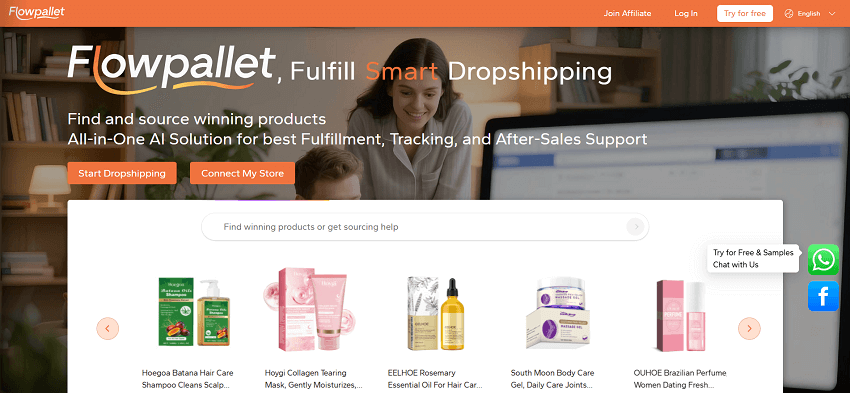
For businesses that want to test products before committing to large orders, platforms like Flowpallet offer a practical advantage. By combining private label options with dropshipping fulfillment, Flowpallet provides sellers a chance to launch branded products with lower upfront risk while keeping operations simple.
Moreover, Flowpallet can reduce much of the operational friction. Instead of managing multiple suppliers and logistics partners, it helps connect private label sellers with vetted manufacturers and streamlined fulfillment solutions, making it easier to maintain product quality while scaling efficiently.
In the long run, choosing a manufacturer that supports both scalability and flexible fulfillment models can help your brand grow faster and more sustainably.
Part 6: Final thoughts
Private labeling is one of the most effective ways to build a brand without reinventing the wheel. When done right, it combines speed, scalability, and brand ownership - making it a powerful model for modern e-commerce and retail businesses.
The key lies in smart product selection, reliable manufacturing partners, and a clear brand strategy that sets you apart from the competition.
