'/%3e%3cpath%20d='M59.9558%200H51.6287C51.6287%200%2045.5566%2034.1414%2045.7996%2039.9704C48.4659%20103.923%20122.41%2090.4886%20159.049%2075.7773L159.882%2071.6137C72.4464%20100.759%2053.2939%2059.9557%2054.1268%2039.9704C54.7163%2025.8265%2059.9558%200%2059.9558%200Z'%20fill='url(%23paint1_linear_658_5274)'/%3e%3cpath%20d='M180.7%2050.7959L180.845%2049.8037C184.282%2054.4129%20189.53%2057.458%20195.688%2057.458C206.726%2057.458%20217.339%2046.0121%20217.339%2034.9746C217.339%2023.9371%20211.722%2015.8223%20200.685%2015.8223C195.356%2015.8223%20189.544%2018.1027%20184.957%2021.7031L185.696%2016.6543H177.369L168.209%2075.7773H176.536L180.7%2050.7959ZM194.023%2049.9629C183.198%2049.1302%20183.198%2041.6353%20183.198%2037.4717C183.198%2028.3123%20190.455%2023.3157%20197.354%2023.3154C204.252%2023.3154%20208.18%2027.6155%20208.18%2034.9736C208.18%2044.1334%20200.922%2049.9627%20194.023%2049.9629Z'%20fill='%23FBFBFB'/%3e%3cpath%20d='M221.503%2050.7954C226.722%2063.8433%20244.819%2055.7917%20248.982%2050.7954C247.65%2056.7908%20255.088%2057.1796%20258.974%2056.6245L259.807%2049.1304C258.697%2049.1304%20256.476%2048.6308%20256.476%2046.6323C256.476%2044.1342%20260.451%2031.2297%20258.974%2025.814C253.978%207.49469%20228.164%2015.8221%20225.666%2024.9819L231.495%2028.312C242.32%2016.6545%20253.146%2024.9814%20249.815%2031.6431C239.823%2029.1449%20214.842%2034.1413%20221.503%2050.7954ZM248.982%2038.3052C250.648%2045.7997%20233.994%2056.6248%20229.83%2046.6323C227.054%2039.9706%20241.488%2037.4725%20248.982%2038.3052Z'%20fill='%23FBFBFB'/%3e%3cdefs%3e%3clinearGradient%20id='paint0_linear_658_5274'%20x1='333.92'%20y1='70.601'%20x2='188.194'%20y2='70.601'%20gradientUnits='userSpaceOnUse'%3e%3cstop%20stop-color='%23EB5455'/%3e%3cstop%20offset='0.0001'%20stop-color='%23EF733E'/%3e%3cstop%20offset='1'%20stop-color='%23FFD461'/%3e%3c/linearGradient%3e%3clinearGradient%20id='paint1_linear_658_5274'%20x1='139.897'%20y1='83.2717'%20x2='53.2939'%20y2='3.33085'%20gradientUnits='userSpaceOnUse'%3e%3cstop%20stop-color='%23FFD461'/%3e%3cstop%20offset='0.9999'%20stop-color='%23EF733E'/%3e%3c/linearGradient%3e%3c/defs%3e%3c/svg%3e)


What Is White Labeling a Product? How does it work?
FlowpalletAurora ShawJun. 12, 2026

White-label products have become a practical shortcut for brands that want to enter a market fast without building everything from scratch.
Whether you're launching a new e-commerce store or expanding your product line, white-labelling offers a way to sell ready-made products under your own brand - without the cost and complexity of manufacturing. Keep reading to learn deeply what a white-label product is.
Part 1: What is a white-label product?
A white-label product is a generic, pre-made item that manufacturers create for multiple businesses to rebrand and sell as their own. You don't handle production—you simply add your logo, packaging, or minor customizations, then market it to customers.
It differs slightly from private label:
(1) White Labeling: Purchasing a generic, mass-produced product and rebranding it as your own. Competitors have access to the same base product.
💡Example: Putting your logo on a standard hand sanitizer bottle that other companies can also rebrand.
(2) Private Labeling: Commissioning a manufacturer to create a product exclusively for your brand, often to your custom specifications.
💡Example: Hiring a chemical company to develop a unique hand sanitizer formula that only you can sell.
In short, private-label items are made exclusively for one retailer, while white-label products are sold to many sellers with minimal differentiation.
Part 2: How white-label products work
To start white labeling, you first identify a supplier for your chosen product. Given the abundance of specialized white-label companies, this is usually straightforward:
- The manufacturer produces a product in bulk.
- Businesses choose the product they want to sell.
- Branding and packaging are applied according to each seller's needs.
- The seller promotes and distributes the product under their own brand.
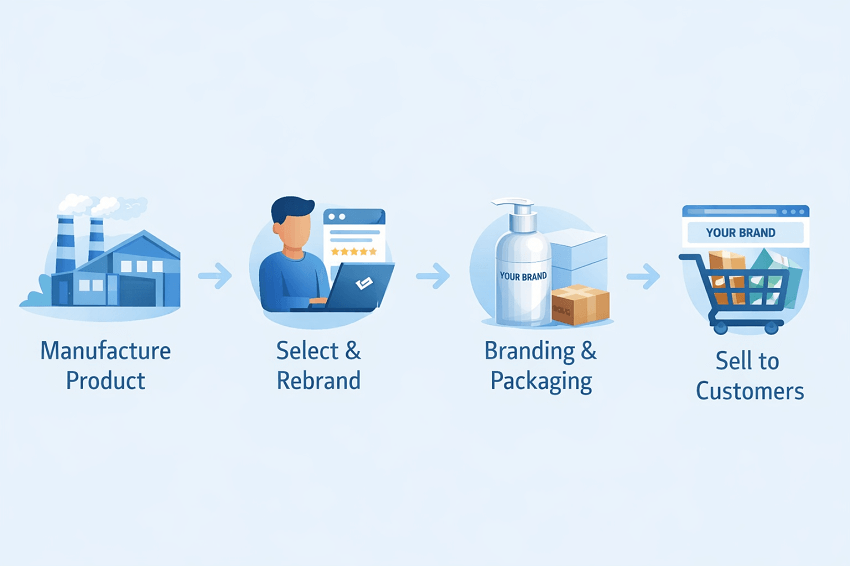
In many cases, sellers can customize colors, packaging, ingredients, or add-ons, but the core product stays the same. This allows companies to launch quickly while keeping costs predictable.
Flowpallet is a prime example, offering a wide array of white-label products—from fashion and jewelry to home decor—that can be customized with your logo and packaging. It significantly cuts down product development time, as you can sell an existing generic item under your own brand instead of creating something from scratch.
Part 3: Types and examples of white-label products
White-label products cover a wide range of physical goods, digital tools, and service-based offerings. Because the model is built around pre-made products that businesses can rebrand, it gives sellers the flexibility to enter different markets without heavy upfront investment. Below are the main categories:
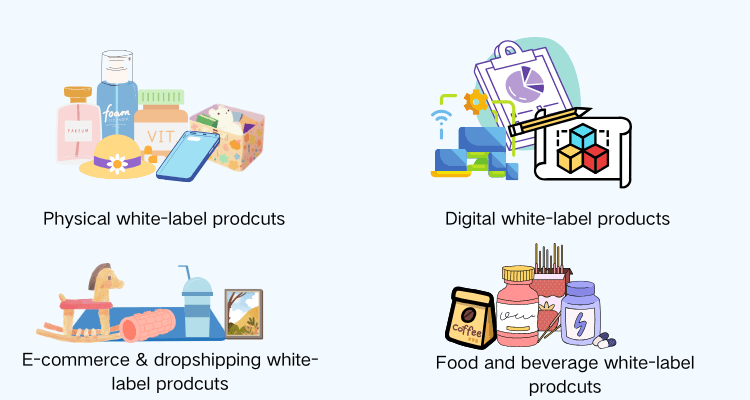
Physical white-label products
These are ready-made consumer goods manufactured in bulk. Sellers simply add their own branding and packaging. Examples include:
- Skincare and beauty: moisturizers, serums, masks, essential oils
- Health and nutrition: vitamins, protein powders, supplements
- Home and kitchen items: storage containers, utensils, organizers, small appliances
- Fashion and accessories: leggings, T-shirts, hats, sunglasses
- Electronics accessories: phone cases, charging cables, earbuds
These products work well for e-commerce brands because demand is consistent and customization options (like labels or packaging) are simple.
Digital white-label products
Software or digital tools that businesses can rebrand as their own. Like:
- SaaS dashboards: social media schedulers, CRMs
- Marketing tools: email automation, SEO dashboards
- E-learning templates: online course platforms, training modules
- Productivity apps: project management, invoicing tools
E-Commerce & Dropshipping white-label products
These products are often sourced from manufacturers who offer customizable options tailored for online sellers. Examples include:
- Fitness gear: resistance bands, yoga mats, water bottles
- Pet supplies: grooming kits, toys, feeders
- Beauty devices: facial rollers, mini massagers, LED masks
- Home improvement tools: LED lights, smart home accessories
Because these products often require minimal customization, sellers can launch quickly and test new niches with low risk.
Food and Beverage White-Label Products
Retailers frequently use white-label manufacturing to build their own branded food lines. Examples include:
- Coffee blends
- Snacks and protein bars
- Private-brand grocery items
- Bottled drinks and supplements
Part 4: How to start selling white-label products
Starting with white-label products is easier than building your own line, but choosing the right direction still matters. Here's a simple path to follow:
- Research your niche: Identify products with steady demand and low saturation.
- Evaluate suppliers: Check product quality, certifications, lead times, and customization options.
- Create a brand identity: Packaging, labeling, and storytelling help you stand out—even if the product is shared across sellers.
- Price strategically: Consider cost, competitors, perceived value, and your target audience.
- Use reliable tools and platforms: Platforms like Flowpallet help you sync your orders in stores, discover various white-label products, design your package, and auto-fulfill your orders, so you avoid wasting time and effort.
- Launch and optimize: Promote your product, gather feedback, and adjust your marketing and positioning as needed.
White-label products give you a flexible, low-risk way to build a brand that customers recognize and trust. With the right niche, quality supplier, and tools like Flowpallet to guide your product decisions, you can bring new products to market quickly and confidently.
Hope you can find your wanted white-label products in the end~
