'/%3e%3cpath%20d='M59.9558%200H51.6287C51.6287%200%2045.5566%2034.1414%2045.7996%2039.9704C48.4659%20103.923%20122.41%2090.4886%20159.049%2075.7773L159.882%2071.6137C72.4464%20100.759%2053.2939%2059.9557%2054.1268%2039.9704C54.7163%2025.8265%2059.9558%200%2059.9558%200Z'%20fill='url(%23paint1_linear_658_5274)'/%3e%3cpath%20d='M180.7%2050.7959L180.845%2049.8037C184.282%2054.4129%20189.53%2057.458%20195.688%2057.458C206.726%2057.458%20217.339%2046.0121%20217.339%2034.9746C217.339%2023.9371%20211.722%2015.8223%20200.685%2015.8223C195.356%2015.8223%20189.544%2018.1027%20184.957%2021.7031L185.696%2016.6543H177.369L168.209%2075.7773H176.536L180.7%2050.7959ZM194.023%2049.9629C183.198%2049.1302%20183.198%2041.6353%20183.198%2037.4717C183.198%2028.3123%20190.455%2023.3157%20197.354%2023.3154C204.252%2023.3154%20208.18%2027.6155%20208.18%2034.9736C208.18%2044.1334%20200.922%2049.9627%20194.023%2049.9629Z'%20fill='%23FBFBFB'/%3e%3cpath%20d='M221.503%2050.7954C226.722%2063.8433%20244.819%2055.7917%20248.982%2050.7954C247.65%2056.7908%20255.088%2057.1796%20258.974%2056.6245L259.807%2049.1304C258.697%2049.1304%20256.476%2048.6308%20256.476%2046.6323C256.476%2044.1342%20260.451%2031.2297%20258.974%2025.814C253.978%207.49469%20228.164%2015.8221%20225.666%2024.9819L231.495%2028.312C242.32%2016.6545%20253.146%2024.9814%20249.815%2031.6431C239.823%2029.1449%20214.842%2034.1413%20221.503%2050.7954ZM248.982%2038.3052C250.648%2045.7997%20233.994%2056.6248%20229.83%2046.6323C227.054%2039.9706%20241.488%2037.4725%20248.982%2038.3052Z'%20fill='%23FBFBFB'/%3e%3cdefs%3e%3clinearGradient%20id='paint0_linear_658_5274'%20x1='333.92'%20y1='70.601'%20x2='188.194'%20y2='70.601'%20gradientUnits='userSpaceOnUse'%3e%3cstop%20stop-color='%23EB5455'/%3e%3cstop%20offset='0.0001'%20stop-color='%23EF733E'/%3e%3cstop%20offset='1'%20stop-color='%23FFD461'/%3e%3c/linearGradient%3e%3clinearGradient%20id='paint1_linear_658_5274'%20x1='139.897'%20y1='83.2717'%20x2='53.2939'%20y2='3.33085'%20gradientUnits='userSpaceOnUse'%3e%3cstop%20stop-color='%23FFD461'/%3e%3cstop%20offset='0.9999'%20stop-color='%23EF733E'/%3e%3c/linearGradient%3e%3c/defs%3e%3c/svg%3e)


Complete Guide to Third-Party Logistics: Everything to Know
FlowpalletAurora ShawJun. 11, 2026

Do you consider a much more convenient logistics, or do you wanna change to a third-party logistics? As e-commerce grows, logistics quickly becomes the biggest operational challenge for online sellers.
Storing inventory, packing orders, managing returns, and shipping worldwide can take more time than marketing or product development. That's why many brands turn to 3PL logistics providers to handle fulfillment professionally and efficiently.
But what exactly is 3PL service? How does it work? And more importantly, how do you choose the right one for your business? This guide breaks it down in simple terms. Keep reading~
1. What is 3PL logistics? How does it work?
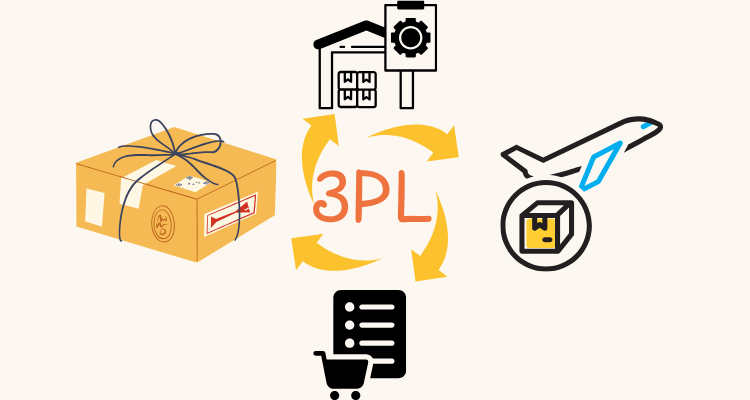
3PL stands for third-party logistics. It is the practice of outsourcing a company's supply chain operations—such as inventory management, order fulfillment, and shipping—to an external expert.
In short, instead of storing products at home or in your own warehouse, you send your inventory to a 3PL warehouse. From there, the 3PL handles:
- Inventory storage
- Order pick and pack fulfillment
- Shipping to customers
- Tracking updates
- Returns management
How 3PL logistics work:
- You send bulk inventory to the 3PL warehouse.
- Your store (Shopify, WooCommerce, Amazon, etc.) connects to the 3PL supplier system.
- A customer places an order in your store.
- The order is automatically sent to the 3PL.
- The 3PL picks, packs, and ships the product to the customer
In fact, you don't touch the product at all.
2. Why choose a 3Pl logistics provider?
Many sellers start by fulfilling orders themselves. But as order volume grows, self-fulfillment becomes slow, stressful, and expensive. Here's why businesses move to 3PL:
- Faster shipping: 3PL warehouses are strategically located, allowing faster domestic and international delivery.
- Scalability: Whether you have 50 orders a day or 5,000, a 3PL can handle the volume without you hiring staff or renting space.
- Lower operational burden: No more packing boxes, managing stock, or handling returns yourself.
- Professional inventory management: Real-time stock tracking reduces errors, overselling, and delays.
- Cost efficiency: Transform fixed logistics overhead into variable costs, paying only for the services you use.
- Better customer experience: Faster delivery and reliable fulfillment lead to higher customer satisfaction and fewer complaints.
In short, choosing a 3PL is less about outsourcing tasks and more about removing operational limits to your growth. Once fulfillment is handled by professionals, you gain the time, speed, and flexibility needed to focus on scaling your business rather than managing daily logistics.
3. Types of 3PL logistics & xPL comparison
Not all 3PL providers are the same. Some focus on traditional logistics, while others are built specifically for e-commerce sellers.
Types of 3PL providers
- Domestic 3PL: Warehouses within one country for local shipping
- International 3PL: Multiple global warehouses for cross-border eCommerce
- eCommerce-focused 3PL: Integrated with Shopify, WooCommerce, and marketplaces
- Industry-specific 3PL: Specialized in beauty, cosmetics, fragile goods, or temperature-sensitive items
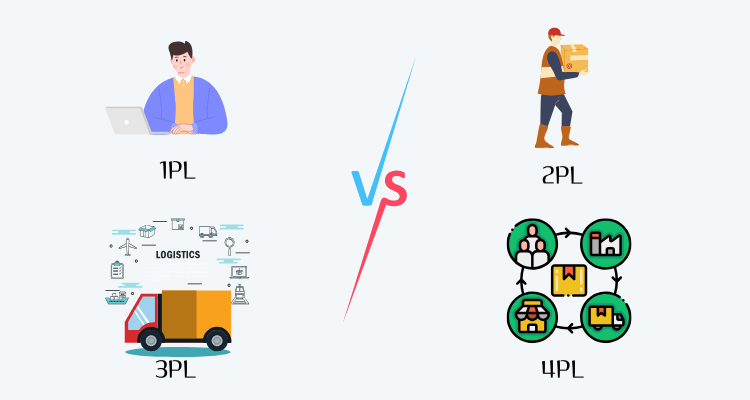
As logistics models evolve, you'll often hear terms like 1PL, 2PL, 3PL, and 4PL. These "xPL" categories describe who is responsible for different parts of the supply chain—from storage and shipping to full logistics management. You should know:
- 1PL (First-Party Logistics): You handle storage, packing, and shipping yourself.
- 2PL (Second-Party Logistics): A carrier transports your goods, but you still manage warehousing and orders.
- 3PL (Third-Party Logistics): A logistics partner handles warehousing, fulfillment, and shipping for you.
- 4PL (Fourth-Party Logistics): A company manages your entire supply chain and coordinates multiple logistics providers.
See the differences here:
| Type | Who handles logistics | What they do | Best for | Limitation |
|---|---|---|---|---|
| 1PL | Yourself | Store, pack, and ship orders | Very small sellers | Time-consuming, not scalable |
| 2PL | Shipping carrier | Transportation only | Business with its own warehouse | Still manage operations yourself |
| 3PL | Logistics partner | Warehousing, picking, packing, shipping, returns | Growing eCommerce brands | Need reliable partner selection |
| 4PL | Supply chain manager | Oversees entire logistics network | Large enterprises | Expensive, complex setup |
For most online sellers, 3PL is the practical and scalable choice.
4. How to choose the right 3PL logistics service?
With a foundation in 3PL knowledge, your focus shifts to 3PL partner selection. This strategic decision requires assessing key provider traits:
- Warehouse locations: Are warehouses close to your target customers? This directly affects shipping speed and cost.
- System integration: Does the 3PL connect smoothly with Shopify, WooCommerce, Amazon, or your store platform?
- Transparent pricing: Look for clear pricing on storage, picking, packing, and shipping. Avoid hidden fees.
- Inventory visibility: You should be able to see stock levels in real time.
- Returns handling: A good 3PL has a clear and efficient returns process.
- Innovative technological solution: Advanced management tools (WMS) and compatibility with e-commerce tools (such as automated fulfillment, POD, ODM, etc.), facilitating process integration and brand promotion.
- Experience with your product type: Some 3PLs are better at handling cosmetics, fragile items, or high-SKU stores.
Ultimately, the right 3PL partner is defined by how closely their technical capabilities match your unique needs. Here, Flowpallet 3PL service is built specifically for eCommerce sellers who need more than just warehousing.
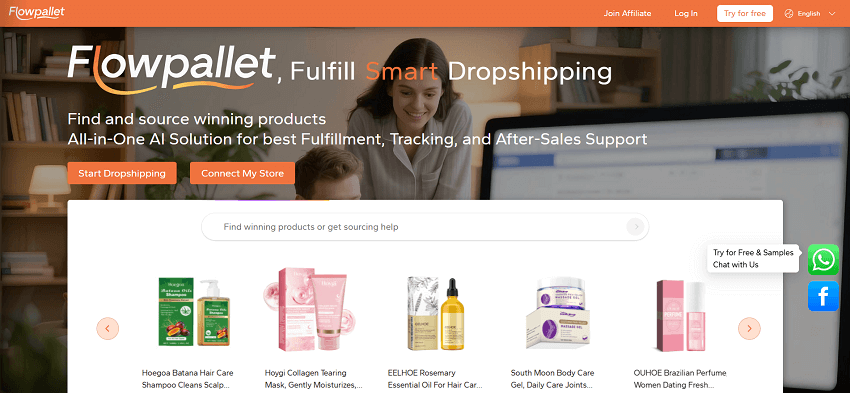
It combines:
- Automated fulfillment
- Seamless system integration with major platforms
- Experience in beauty, cosmetics, and daily items logistics
- The ability to support both dropshipping and stocked inventory models
- More advanced options like POD, white label, bulk orders, and so on
- Warm after-sales and 7/24 online services
This is especially useful for sellers who start with dropshipping and later transition into bulk inventory and 3PL fulfillment without changing partners. With Flowpallet, you can scale from testing products to full inventory management in one ecosystem. Have a try~
Also read: How to start a dropshipping business
5. Conclusion
3PL logistics is no longer something only large companies use. For modern e-commerce sellers, it's often the key to scaling without being overwhelmed by operational work.
By outsourcing storage, packing, shipping, and returns to a reliable 3PL partner, you free up time to focus on marketing, branding, and growth.
The key is choosing a provider with the right warehouse network, technology integration, transparent pricing, and experience in your product category. When selected carefully, a 3PL partner like Flowpallet can become a long-term foundation for your business expansion.
