'/%3e%3cpath%20d='M59.9558%200H51.6287C51.6287%200%2045.5566%2034.1414%2045.7996%2039.9704C48.4659%20103.923%20122.41%2090.4886%20159.049%2075.7773L159.882%2071.6137C72.4464%20100.759%2053.2939%2059.9557%2054.1268%2039.9704C54.7163%2025.8265%2059.9558%200%2059.9558%200Z'%20fill='url(%23paint1_linear_658_5274)'/%3e%3cpath%20d='M180.7%2050.7959L180.845%2049.8037C184.282%2054.4129%20189.53%2057.458%20195.688%2057.458C206.726%2057.458%20217.339%2046.0121%20217.339%2034.9746C217.339%2023.9371%20211.722%2015.8223%20200.685%2015.8223C195.356%2015.8223%20189.544%2018.1027%20184.957%2021.7031L185.696%2016.6543H177.369L168.209%2075.7773H176.536L180.7%2050.7959ZM194.023%2049.9629C183.198%2049.1302%20183.198%2041.6353%20183.198%2037.4717C183.198%2028.3123%20190.455%2023.3157%20197.354%2023.3154C204.252%2023.3154%20208.18%2027.6155%20208.18%2034.9736C208.18%2044.1334%20200.922%2049.9627%20194.023%2049.9629Z'%20fill='%23FBFBFB'/%3e%3cpath%20d='M221.503%2050.7954C226.722%2063.8433%20244.819%2055.7917%20248.982%2050.7954C247.65%2056.7908%20255.088%2057.1796%20258.974%2056.6245L259.807%2049.1304C258.697%2049.1304%20256.476%2048.6308%20256.476%2046.6323C256.476%2044.1342%20260.451%2031.2297%20258.974%2025.814C253.978%207.49469%20228.164%2015.8221%20225.666%2024.9819L231.495%2028.312C242.32%2016.6545%20253.146%2024.9814%20249.815%2031.6431C239.823%2029.1449%20214.842%2034.1413%20221.503%2050.7954ZM248.982%2038.3052C250.648%2045.7997%20233.994%2056.6248%20229.83%2046.6323C227.054%2039.9706%20241.488%2037.4725%20248.982%2038.3052Z'%20fill='%23FBFBFB'/%3e%3cdefs%3e%3clinearGradient%20id='paint0_linear_658_5274'%20x1='333.92'%20y1='70.601'%20x2='188.194'%20y2='70.601'%20gradientUnits='userSpaceOnUse'%3e%3cstop%20stop-color='%23EB5455'/%3e%3cstop%20offset='0.0001'%20stop-color='%23EF733E'/%3e%3cstop%20offset='1'%20stop-color='%23FFD461'/%3e%3c/linearGradient%3e%3clinearGradient%20id='paint1_linear_658_5274'%20x1='139.897'%20y1='83.2717'%20x2='53.2939'%20y2='3.33085'%20gradientUnits='userSpaceOnUse'%3e%3cstop%20stop-color='%23FFD461'/%3e%3cstop%20offset='0.9999'%20stop-color='%23EF733E'/%3e%3c/linearGradient%3e%3c/defs%3e%3c/svg%3e)


A Full Guide to Start Pick and Pack Fulfillment Service
FlowpalletAurora ShawJun. 11, 2026

Fast, accurate order fulfillment is the backbone of every successful eCommerce business. No matter how great your products or marketing are, customers ultimately judge your brand by how quickly and correctly their orders arrive. This is where pick and pack fulfillment plays a critical role.
No matter what you're selling online, getting your pick and pack right makes all the difference. It's all about getting orders out the door quickly and correctly. Honestly, that's why so many businesses work with fulfillment experts early on—to avoid the headaches and bottlenecks that come with scaling up.
In this guide, you'll learn exactly what pick and pack fulfillment is, how it works step by step, its benefits and challenges, and how to choose the right fulfillment partner.
1. What is pick and pack fulfillment?
Pick and pack fulfillment is a warehouse process where individual items are picked from the inventory based on a customer's order, carefully packed, and then shipped to the customer.
It's a core part of the order fulfillment workflow and sits between inventory storage and final delivery. Unlike general warehousing, which focuses mainly on storing products, pick and pack fulfillment is about accurate order handling at the SKU level.
Picture this: a customer clicks "buy" on your online store, and their entire experience hinges on one thing—accuracy. In this process, your fulfillment partner serves the seller, who serves the end customer. Smooth, professional handling benefits everyone in that chain.
The service can also be customized, like using the seller's own branded packaging. And in the end, "shipping" is the final act of the pick-and-pack story. This process is especially important for e-commerce businesses that handle a high number of small, multi-item orders daily.
2. How pick and pack fulfillment works (step-by-step)
Before an order reaches your customer's doorstep, it goes through a carefully structured warehouse process. Pick and pack fulfillment is not random manual work - it follows a precise workflow designed to maximize speed, accuracy, and efficiency. Let's see the detailed process:
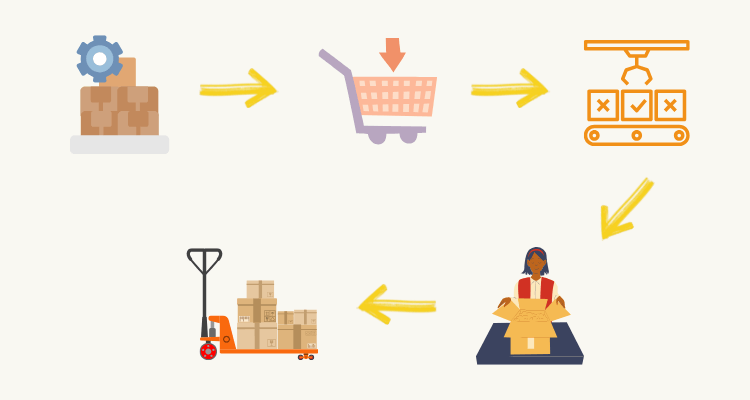
#01 Inventory storage and organization
Everything starts with proper inventory organization. Products are labeled with SKUs, stored in clearly marked bin locations, and tracked using a warehouse management system (WMS).
A well-organized warehouse reduces picking time and minimizes errors. Professional fulfillment partners like Flowpallet design their warehouse layout around SKU-level organization and real-time order synchronization with online stores, ensuring seamless order fulfillment at all times. It offers 3PL logistics, too.
#02 Order receiving
When a customer places an order on your website, thanks to a smart connection to the warehouse system, the order details are automatically synced to the warehouse system. Orders can be processed individually or grouped using batch processing for efficiency.
Automation at this stage prevents manual errors and speeds up the workflow. Your partner sends the order to the location that has the item in stock and can get it to your customer the fastest.
#03 Pick the items
Warehouse staff locate and pick the exact items listed in the order. Depending on order volume and warehouse layout, different picking methods are used to improve speed and accuracy:
- Piece picking: One worker picks items for one order at a time. This is simple and suitable for low-order volumes, but can be time-consuming when orders increase.
- Batch picking: The picker collects items for multiple orders in one trip, reducing walking time and improving efficiency for high-volume stores.
- Zone picking: The warehouse is divided into zones, and each worker is responsible for picking items only within their assigned area. Orders move between zones until completed.
- Wave picking: Orders are grouped and picked in scheduled waves based on shipping times, carrier schedules, or product types, making it ideal for busy fulfillment centers.
Advanced 3PL providers use optimized picking strategies like batch and zone picking to reduce walking time, improve speed, and significantly lower picking errors.
#04 Packing the order
Once picked, items move to the packing station. Here, staff select the right packaging materials, protect the products, and add any necessary inserts, branding materials, or invoices.
Proper packing not only protects the items but also enhances the customer's unboxing experience. How long packing takes depends on the products and any special instructions from the brand. To work faster, many large warehouses now use AI packing software, which recommends the best packing methods to save time and reduce errors.
#05 Shipping and tracking
Finally, shipping labels are generated, parcels are sorted by carrier, and orders are dispatched for delivery. At this stage, accuracy is crucial—incorrect labels or carrier selection can lead to delays and customer complaints.
Once shipped, tracking numbers are automatically synced back to the online store and sent to customers, allowing them to monitor their delivery in real time. This transparency not only improves customer experience but also reduces the number of support inquiries about order status.
In professional fulfillment centers like Flowpallet, shipping and tracking are fully integrated with store systems and carrier networks, ensuring faster dispatch, fewer errors, and smooth last-mile delivery.
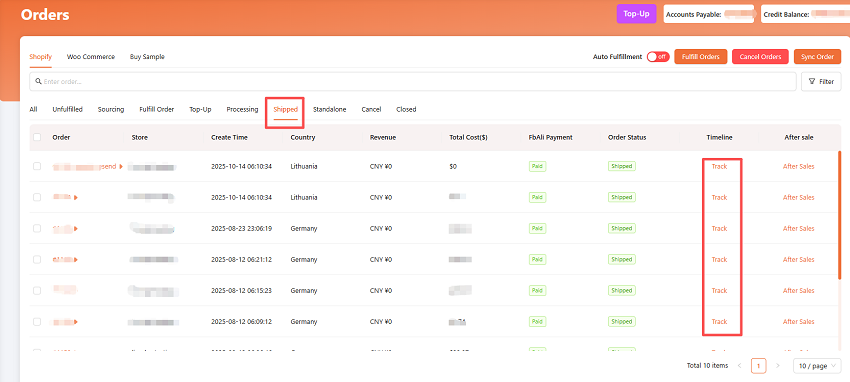
Together, these steps form a seamless pick and pack cycle that ensures orders are processed quickly and accurately. When this workflow is optimized, it not only reduces operational costs but also creates a smoother experience for both sellers and customers.
3. Benefits and challenges of pick and pack fulfillment
Before deciding whether to handle pick and pack in-house or outsource it, it's important to understand both its advantages and its operational difficulties.
| Benefits | Challenges |
|---|---|
| Faster order processing | Picking errors due to poor organization |
| Higher picking accuracy | Inventory mismatches |
| Lower labor costs through optimized workflows | Slow packing speed during peak seasons |
| Better customer experience with timely deliveries | Inefficient warehouse layout |
| Scalability for growing order volumes | High labor and management costs |
These challenges are exactly why many eCommerce sellers turn to professional 3PL service partners like Flowpallet, where standardized pick and pack systems are already in place and optimized for efficiency.
Read more: How to start a dropshipping business?
4. How to choose a pick and pack fulfillment supplier?
Choosing the right fulfillment partner can directly impact your customer satisfaction and operational costs. Here are key factors to consider:
- Real-time inventory management system
- Experience with e-commerce and dropshipping orders
- Efficient picking methods and warehouse layout
- Custom packing and branding options
- Reliable shipping partnerships and tracking integration
- Scalability as your order volume grows
For sellers involved in dropshipping, private label, white-label products, or wholesale, working with a provider like Flowpallet can simplify operations significantly. With integrated inventory management, optimized pick and pack workflows, and seamless store integration, you can focus on growing your business while fulfillment runs smoothly in the background.
5. Conclusion
Pick and pack fulfillment is more than a warehouse task — it is a crucial process that determines how efficiently your orders reach customers. By understanding how it works and recognizing its challenges, you can make smarter decisions about whether to manage it in-house or partner with a professional fulfillment provider.
As your e-commerce business grows, having a reliable pick and pack system - whether internally or through partners - becomes essential for delivering consistent, high-quality customer experiences.
Hope you have an enjoyable e-commerce journey.
