'/%3e%3cpath%20d='M59.9558%200H51.6287C51.6287%200%2045.5566%2034.1414%2045.7996%2039.9704C48.4659%20103.923%20122.41%2090.4886%20159.049%2075.7773L159.882%2071.6137C72.4464%20100.759%2053.2939%2059.9557%2054.1268%2039.9704C54.7163%2025.8265%2059.9558%200%2059.9558%200Z'%20fill='url(%23paint1_linear_658_5274)'/%3e%3cpath%20d='M180.7%2050.7959L180.845%2049.8037C184.282%2054.4129%20189.53%2057.458%20195.688%2057.458C206.726%2057.458%20217.339%2046.0121%20217.339%2034.9746C217.339%2023.9371%20211.722%2015.8223%20200.685%2015.8223C195.356%2015.8223%20189.544%2018.1027%20184.957%2021.7031L185.696%2016.6543H177.369L168.209%2075.7773H176.536L180.7%2050.7959ZM194.023%2049.9629C183.198%2049.1302%20183.198%2041.6353%20183.198%2037.4717C183.198%2028.3123%20190.455%2023.3157%20197.354%2023.3154C204.252%2023.3154%20208.18%2027.6155%20208.18%2034.9736C208.18%2044.1334%20200.922%2049.9627%20194.023%2049.9629Z'%20fill='%23FBFBFB'/%3e%3cpath%20d='M221.503%2050.7954C226.722%2063.8433%20244.819%2055.7917%20248.982%2050.7954C247.65%2056.7908%20255.088%2057.1796%20258.974%2056.6245L259.807%2049.1304C258.697%2049.1304%20256.476%2048.6308%20256.476%2046.6323C256.476%2044.1342%20260.451%2031.2297%20258.974%2025.814C253.978%207.49469%20228.164%2015.8221%20225.666%2024.9819L231.495%2028.312C242.32%2016.6545%20253.146%2024.9814%20249.815%2031.6431C239.823%2029.1449%20214.842%2034.1413%20221.503%2050.7954ZM248.982%2038.3052C250.648%2045.7997%20233.994%2056.6248%20229.83%2046.6323C227.054%2039.9706%20241.488%2037.4725%20248.982%2038.3052Z'%20fill='%23FBFBFB'/%3e%3cdefs%3e%3clinearGradient%20id='paint0_linear_658_5274'%20x1='333.92'%20y1='70.601'%20x2='188.194'%20y2='70.601'%20gradientUnits='userSpaceOnUse'%3e%3cstop%20stop-color='%23EB5455'/%3e%3cstop%20offset='0.0001'%20stop-color='%23EF733E'/%3e%3cstop%20offset='1'%20stop-color='%23FFD461'/%3e%3c/linearGradient%3e%3clinearGradient%20id='paint1_linear_658_5274'%20x1='139.897'%20y1='83.2717'%20x2='53.2939'%20y2='3.33085'%20gradientUnits='userSpaceOnUse'%3e%3cstop%20stop-color='%23FFD461'/%3e%3cstop%20offset='0.9999'%20stop-color='%23EF733E'/%3e%3c/linearGradient%3e%3c/defs%3e%3c/svg%3e)


The Challenges of Dropshipping: Best Guide to Overcome
FlowpalletAurora ShawSep. 8, 2026

Dropshipping is still one of the simplest ways to launch an online business, but it is not as easy as it often looks on social media.
Because you do not manage inventory or shipping yourself, your success relies heavily on suppliers, fulfillment partners, and meeting customer expectations. Issues like delayed deliveries, low product quality, or stock errors can quickly lead to negative reviews and lost sales.
The good news is that most dropshipping challenges or problems can be anticipated—and avoided. By choosing reliable dropshipping suppliers, using the right tools, and setting up efficient processes, you can prevent many common issues before they impact your business.
I wanna know what the biggest challenges are for beginners, because I need to start one. -reddit.com
In this guide, we will explore the biggest challenges in dropshipping and practical solutions to overcome them.
1. What are the biggest dropshipping challenges + solutions
Almost every dropshipper runs into similar challenges, especially in the first year. Below are the most common issues and how they can impact your business.
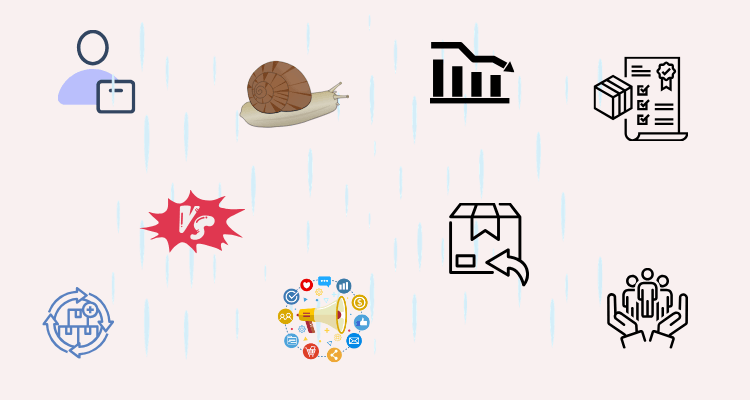
❗Finding reliable suppliers
Your supplier is the backbone of your business. When something goes wrong, customers hold you responsible- not the supplier.
Common problems include inconsistent product quality, slow responses, delayed shipping, incorrect orders, and unexpected stock shortages.
🔑How to: Order samples before selling. Check reviews and past performance. Choose suppliers with real-time inventory updates. Work with multiple suppliers for key products to avoid disruptions.
❗Long shipping times
Many suppliers ship from overseas, which can result in long delivery times. This often leads to customer complaints, refund requests, chargebacks, and lower conversion rates.
🔑How to: Work with suppliers that offer local warehouses. Clearly communicate delivery times on your store. Provide tracking information. Consider fulfillment services with faster shipping options.
❗Low profit margins
While dropshipping requires low upfront investment, heavy competition can make pricing difficult.
When many stores sell the same product, lowering prices becomes the easiest—but least sustainable—strategy.
🔑How to: Focus on products with strong perceived value. Bundle complementary items. Use upsells to raise average order value. Build a brand so you are not competing on price alone.
❗Product quality issues
Since you do not handle products directly, quality control can be challenging.
Poor-quality items often result in negative reviews, refunds, support issues, and damage to your brand.
🔑How to: Always test samples. Monitor customer feedback closely. Remove products with repeated complaints. Work with suppliers that perform quality checks.
❗Inventory changes
A product listed as available may actually be out of stock.
Without real-time updates, you risk selling items you cannot fulfill.
🔑How to: Use dropshipping platforms that automatically sync inventory so stock levels stay accurate before customers place orders.
❗High competition
Dropshipping is easy to start, so many sellers target the same trending products.
Instead of competing directly, focus on standing out.
🔑How to: You can differentiate by building a niche store, writing better product descriptions, creating helpful content, offering faster support, and developing a strong brand identity
❗Marketing costs
Many beginners underestimate how expensive it is to acquire customers.
Paid ads can quickly become costly, especially if products are not converting well.
🔑How to: To reduce risk, diversify your traffic sources by investing in SEO, email marketing, social media, influencer partnerships, and content marketing. Organic traffic takes time but offers more stable long-term results.
❗Returns and refunds
Handling returns is more complex in dropshipping because products ship directly from suppliers.
Before launching, set clear policies for refunds, return shipping, damaged items, and lost packages.
🔑How to: Transparent policies reduce disputes and improve customer confidence.
❗Managing multiple suppliers
Managing different systems, shipping methods, and communications manually can become overwhelming.
🔑How to: Automation tools become essential as order volume increases, helping you streamline operations and reduce errors.
Hope you can get over all these dropshipping challenges.
2. Tools that make dropshipping easier
Running a successful dropshipping business becomes much simpler when you use the right software. Here are some of the most useful tools:
| Tool | Best For |
|---|---|
| Shopify | Building an online store |
| WooCommerce | WordPress-based ecommerce |
| Google Analytics | Website performance tracking |
| Klaviyo | Email marketing automation |
| Canva | Product graphics and marketing materials |
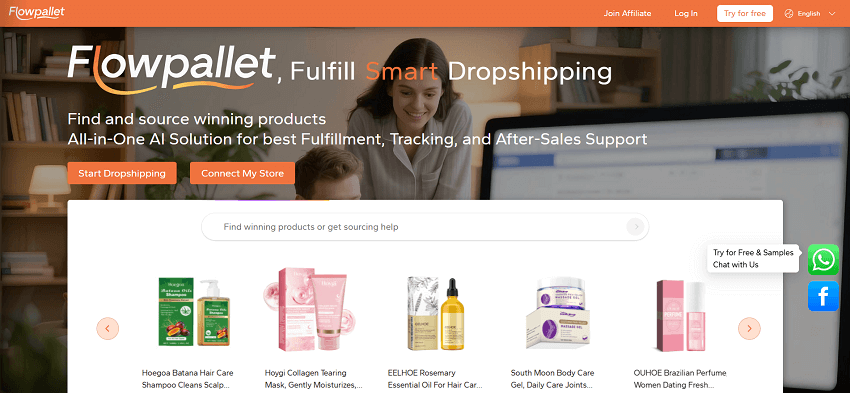
| Flowpallet | Product sourcing, supplier management, fulfillment, and automation |
Why Flowpallet helps reduce common dropshipping challenges
Many major dropshipping challenges come from manually handling multiple suppliers and fulfillment processes.
Flowpallet streamlines these operations by providing an all-in-one solution for product sourcing and order fulfillment.
With Flowpallet, sellers can:
- Source products from trusted, verified suppliers
- Automate the entire order fulfillment process
- Ensure product quality with built-in inspection services
- Monitor inventory with greater accuracy
- Customize products through private labeling or print-on-demand options
- Manage international shipping more easily
Instead of switching between multiple tools and platforms, merchants can handle everything within a single, efficient workflow—reducing errors, saving time, and scaling their business more smoothly.
3. Conclusion
Every e-commerce business encounters challenges, and dropshipping is no different. Issues like unreliable suppliers, shipping delays, stock shortages, and intense competition are common—but they do not have to limit your growth.
Successful dropshippers focus on building strong systems rather than looking for shortcuts. By working with dependable suppliers, automating routine tasks, using tools like Flowpallet to streamline sourcing and fulfillment, and continuously improving the customer experience, you can effectively manage these challenges and grow your business.
Hope everything goes well~
