'/%3e%3cpath%20d='M59.9558%200H51.6287C51.6287%200%2045.5566%2034.1414%2045.7996%2039.9704C48.4659%20103.923%20122.41%2090.4886%20159.049%2075.7773L159.882%2071.6137C72.4464%20100.759%2053.2939%2059.9557%2054.1268%2039.9704C54.7163%2025.8265%2059.9558%200%2059.9558%200Z'%20fill='url(%23paint1_linear_658_5274)'/%3e%3cpath%20d='M180.7%2050.7959L180.845%2049.8037C184.282%2054.4129%20189.53%2057.458%20195.688%2057.458C206.726%2057.458%20217.339%2046.0121%20217.339%2034.9746C217.339%2023.9371%20211.722%2015.8223%20200.685%2015.8223C195.356%2015.8223%20189.544%2018.1027%20184.957%2021.7031L185.696%2016.6543H177.369L168.209%2075.7773H176.536L180.7%2050.7959ZM194.023%2049.9629C183.198%2049.1302%20183.198%2041.6353%20183.198%2037.4717C183.198%2028.3123%20190.455%2023.3157%20197.354%2023.3154C204.252%2023.3154%20208.18%2027.6155%20208.18%2034.9736C208.18%2044.1334%20200.922%2049.9627%20194.023%2049.9629Z'%20fill='%23FBFBFB'/%3e%3cpath%20d='M221.503%2050.7954C226.722%2063.8433%20244.819%2055.7917%20248.982%2050.7954C247.65%2056.7908%20255.088%2057.1796%20258.974%2056.6245L259.807%2049.1304C258.697%2049.1304%20256.476%2048.6308%20256.476%2046.6323C256.476%2044.1342%20260.451%2031.2297%20258.974%2025.814C253.978%207.49469%20228.164%2015.8221%20225.666%2024.9819L231.495%2028.312C242.32%2016.6545%20253.146%2024.9814%20249.815%2031.6431C239.823%2029.1449%20214.842%2034.1413%20221.503%2050.7954ZM248.982%2038.3052C250.648%2045.7997%20233.994%2056.6248%20229.83%2046.6323C227.054%2039.9706%20241.488%2037.4725%20248.982%2038.3052Z'%20fill='%23FBFBFB'/%3e%3cdefs%3e%3clinearGradient%20id='paint0_linear_658_5274'%20x1='333.92'%20y1='70.601'%20x2='188.194'%20y2='70.601'%20gradientUnits='userSpaceOnUse'%3e%3cstop%20stop-color='%23EB5455'/%3e%3cstop%20offset='0.0001'%20stop-color='%23EF733E'/%3e%3cstop%20offset='1'%20stop-color='%23FFD461'/%3e%3c/linearGradient%3e%3clinearGradient%20id='paint1_linear_658_5274'%20x1='139.897'%20y1='83.2717'%20x2='53.2939'%20y2='3.33085'%20gradientUnits='userSpaceOnUse'%3e%3cstop%20stop-color='%23FFD461'/%3e%3cstop%20offset='0.9999'%20stop-color='%23EF733E'/%3e%3c/linearGradient%3e%3c/defs%3e%3c/svg%3e)


[Full Guide] How to Find Products for Dropshipping?
FlowpalletAurora ShawJun. 10, 2026

When you know how to start a dropshipping business, your product choice can make or break your business. Marketing skills, website design, and ad strategies all matter - but if the product doesn't resonate with customers, nothing else will save it. Like this user's doubt:
How do I actually find a winning product? Should I solve a problem first or find a product first? Do I just keep testing until something works? -reddit.com
That's why learning how to find dropshipping products is one of the most important steps for beginners and experienced sellers alkie. In this guide, we'll break down what makes a good dropshipping product, how to validate it, and practical ways to discover winning items - plus where to source them safely and efficiently.
Part 1: What makes a good dropshipping product?
Not every trending product is worth selling. A strong dropshipping product usually has the following characteristics:
📄Clear demand
People are already searching for it or actively buying similar items. You don't want to create demand from scratch—you want to tap into existing interest.
💴Healthy profit margin
After product cost, shipping, transaction fees, and ad spend, you should still have room for profit. Low-ticket items with razor-thin margins are difficult to scale.
✅Lightweight and easy to ship
Bulky or fragile items increase shipping costs and return risks. Smaller, durable products are typically easier to manage.
💡Solves a problem or sparks emotion
Problem-solving products (e.g., convenience, comfort, organization) tend to convert well. Emotional products—like gifts or hobby-related items—also perform strongly.
👁🗨Low return risk
Avoid products with complicated sizing (unless you have strong quality control), high defect rates, or unclear expectations.
In short, a good dropshipping product isn't just popular - it's practical, profitable, and sustainable. When a product meets real demand, offers solid margins, and is easy to fulfill, you’re not just chasing quick sales - you're building a business with long-term potential.
Part 2: How to validate a good dropshipping product
Sourcing a product to sell online is only the first step. Before you invest time, money, and effort into building a store or running ads, you need to make sure the product has real potential, and determine:
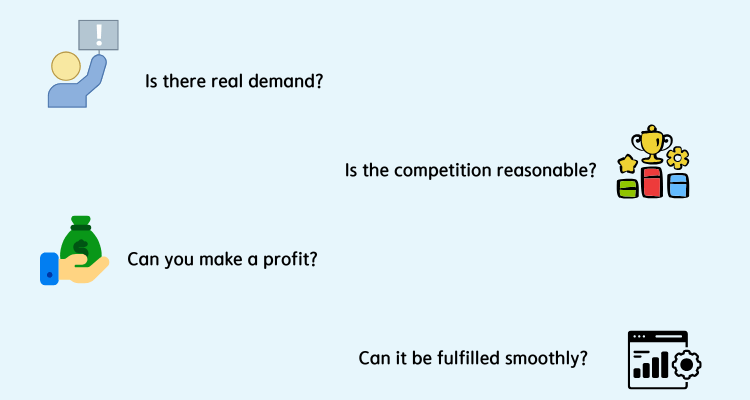
1) Is there real demand?
Search for the product on Google and social media. Are people talking about it? Are stores actively selling it? You can also use keyword tools to see if people are searching for it regularly. Consistent interest is more important than short-term hype.
2) Is the competition reasonable?
Some competition is good- it proves demand exists. But if the market is flooded with identical products at very low prices, it will be harder to stand out. Look for ways to differentiate, such as better branding, bundles, or improved product descriptions.
3) Can you make a profit?
Calculate all costs: product price, shipping, transaction fees, and advertising. Make sure there is still enough margin left. If the numbers are too tight, scaling will be difficult.
4) Can it be fulfilled smoothly?
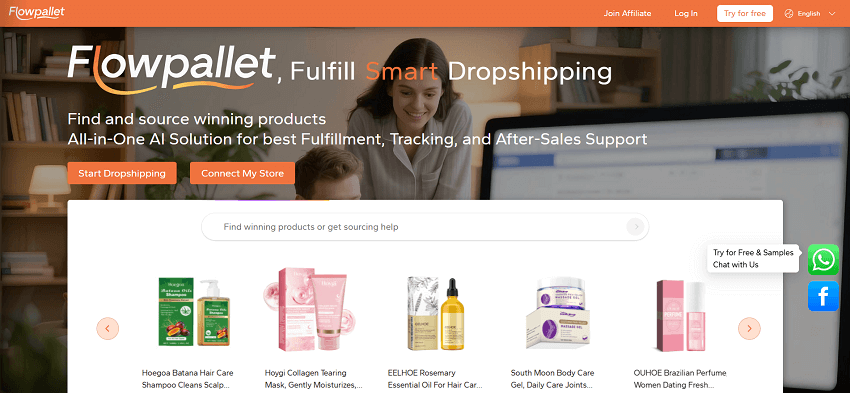
Fast shipping and stable supply are critical. Delays and stock issues can damage your reputation quickly. Working with a structured fulfillment partner like Flowpallet can help ensure more stable sourcing, inventory coordination, and smoother order processing—especially when your order volume increases.
Validation isn't complicated, but it is necessary. A few extra checks at this stage can save you weeks of frustration later.
Part 3: How to find dropshipping products
Now, let's get into the practical side: how to find winning products for dropshipping?
There's no single "secret list" of winning products. Most successful sellers use a mix of research, observation, and testing. The key is to stay curious, pay attention to patterns, and move quickly when you see an opportunity.
Below are some reliable ways to discover potential dropshipping products.
#1 Use online marketplaces
Online marketplaces are one of the easiest places to start. Large platforms already show you what people are buying. You can browse: Best-seller rankings, "Trending" or "Hot" sections, or products with a high number of orders and reviews. Ask yourself:
- Why is this product selling well?
- What problem does it solve?
- Can I improve the offer or target a specific niche?
Reading customer reviews is especially valuable. Reviews often highlight what customers love—and what they wish was better. That feedback can help you position your version more effectively.
#2 Analyze social media trends
Social media is where many products go viral before they hit mainstream stores. Short-form videos are particularly powerful for product discovery. When you see the same type of product appearing repeatedly in ads or organic posts, that's usually a sign of momentum. Pay attention to:
- Engagement (comments, shares, saves)
- Whether people are asking, "Where can I buy this?"
- How creators demonstrate the product
If a product is easy to show in action and immediately makes sense in a 15–30 second video, it often has strong potential.
#3 Study competitor stores
One of the smartest strategies is learning from stores that are already succeeding. Search within a niche you're interested in and study:
- Their best-selling products
- Items featured on their homepage
- Products that have many reviews
If a store continues promoting a product over time, there's a good chance it's generating consistent revenue. Also, look at how competitors present the product:
- What angle are they using?
- Who are they targeting?
- How are they pricing it?
Sometimes the opportunity isn't a brand-new product- it's better branding or better positioning.
#4 Use product research tools
Product research tools can speed up the process by organizing data for you. They can help you track search volume trends, discover products currently being advertised, and analyze engagement data.
While tools are helpful, they're not magic. They point you in a direction, but you still need to evaluate profit margins, fulfillment feasibility, and differentiation.
Think of them as a shortcut—not a guarantee.
At the end of the day, knowing how to find dropshipping products is an ongoing process. You test, analyze, adjust, and repeat. The more you research and observe, the sharper your instincts become—and the easier it is to spot real opportunities.
Part 4: Tip: Where to source dropshipping products?
Finding a product is one thing. Sourcing it properly is another. Here are your main options:
1️⃣Direct suppliers: You can work directly with manufacturers for better pricing, especially if you plan to scale.
2️⃣Sourcing agents: Agents can negotiate prices, check quality, and consolidate shipments.
3️⃣Fulfillment platforms: If you want a more structured and scalable approach, working with a fulfillment partner like Flowpallet can simplify more than just shipping—it can actually support your product selection process as well.
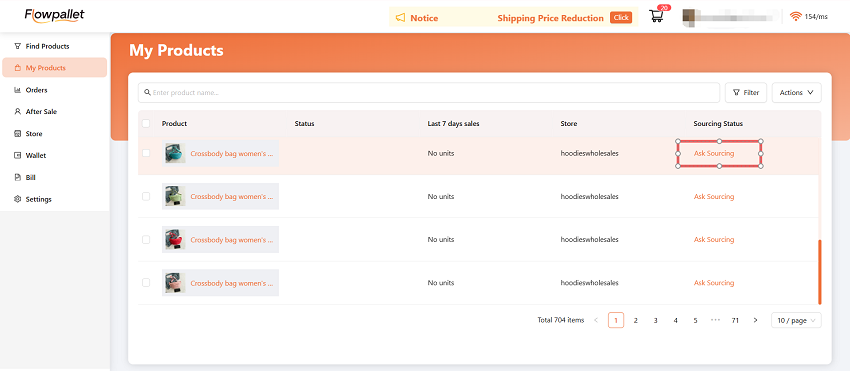
With Flowpallet, product sourcing isn't just about listing items from a marketplace. You can:
- Get help verifying suppliers
- Check and test product quality before scaling
- Consolidate inventory from multiple suppliers
- Improve shipping speed through centralized warehousing
- Plan inventory more strategically once sales grow
As your store grows, manual coordination with multiple suppliers quickly turns messy. A structured partner like Flowpallet helps keep sourcing, inventory, and order fulfillment connected—so your product decisions support long-term growth, not just short-term sales.
Part 5: Final thoughts
Learning how to find dropshipping products isn't about chasing every trend. It's about combining research, validation, and smart sourcing. Remember to focus on: Real demand, sustainable margins, reliable fulfillment, continuous testing, and so on.
With the right process in place - and strong operational support - you can turn product research from guesswork into a repeatable system for growth. Hope that you can work it out~
