'/%3e%3cpath%20d='M59.9558%200H51.6287C51.6287%200%2045.5566%2034.1414%2045.7996%2039.9704C48.4659%20103.923%20122.41%2090.4886%20159.049%2075.7773L159.882%2071.6137C72.4464%20100.759%2053.2939%2059.9557%2054.1268%2039.9704C54.7163%2025.8265%2059.9558%200%2059.9558%200Z'%20fill='url(%23paint1_linear_658_5274)'/%3e%3cpath%20d='M180.7%2050.7959L180.845%2049.8037C184.282%2054.4129%20189.53%2057.458%20195.688%2057.458C206.726%2057.458%20217.339%2046.0121%20217.339%2034.9746C217.339%2023.9371%20211.722%2015.8223%20200.685%2015.8223C195.356%2015.8223%20189.544%2018.1027%20184.957%2021.7031L185.696%2016.6543H177.369L168.209%2075.7773H176.536L180.7%2050.7959ZM194.023%2049.9629C183.198%2049.1302%20183.198%2041.6353%20183.198%2037.4717C183.198%2028.3123%20190.455%2023.3157%20197.354%2023.3154C204.252%2023.3154%20208.18%2027.6155%20208.18%2034.9736C208.18%2044.1334%20200.922%2049.9627%20194.023%2049.9629Z'%20fill='%23FBFBFB'/%3e%3cpath%20d='M221.503%2050.7954C226.722%2063.8433%20244.819%2055.7917%20248.982%2050.7954C247.65%2056.7908%20255.088%2057.1796%20258.974%2056.6245L259.807%2049.1304C258.697%2049.1304%20256.476%2048.6308%20256.476%2046.6323C256.476%2044.1342%20260.451%2031.2297%20258.974%2025.814C253.978%207.49469%20228.164%2015.8221%20225.666%2024.9819L231.495%2028.312C242.32%2016.6545%20253.146%2024.9814%20249.815%2031.6431C239.823%2029.1449%20214.842%2034.1413%20221.503%2050.7954ZM248.982%2038.3052C250.648%2045.7997%20233.994%2056.6248%20229.83%2046.6323C227.054%2039.9706%20241.488%2037.4725%20248.982%2038.3052Z'%20fill='%23FBFBFB'/%3e%3cdefs%3e%3clinearGradient%20id='paint0_linear_658_5274'%20x1='333.92'%20y1='70.601'%20x2='188.194'%20y2='70.601'%20gradientUnits='userSpaceOnUse'%3e%3cstop%20stop-color='%23EB5455'/%3e%3cstop%20offset='0.0001'%20stop-color='%23EF733E'/%3e%3cstop%20offset='1'%20stop-color='%23FFD461'/%3e%3c/linearGradient%3e%3clinearGradient%20id='paint1_linear_658_5274'%20x1='139.897'%20y1='83.2717'%20x2='53.2939'%20y2='3.33085'%20gradientUnits='userSpaceOnUse'%3e%3cstop%20stop-color='%23FFD461'/%3e%3cstop%20offset='0.9999'%20stop-color='%23EF733E'/%3e%3c/linearGradient%3e%3c/defs%3e%3c/svg%3e)


Order Fulfillment Meaning: How to Make It Better?
FlowpalletAurora ShawJun. 10, 2026

Good fulfillment is invisible. Customers don't think about it - they just get their order on time and move on. But when something goes wrong? A late package or a mixed-up order can shake their trust fast.
As e-commerce continues to grow, efficient fulfillment has become more than just an operational task - it's a competitive advantage. Whether you're running a small Shopify store, scaling a dropshipping business, or managing thousands of monthly orders, understanding how order fulfillment works is essential.
1. What is order fulfillment?
Order fulfillment is the end-to-end journey of getting a customer's purchase from the warehouse to the doorstep - covering everything from receiving the order to packaging it up and shipping it out. It starts when a customer places an order and ends when the package successfully reaches the buyer, sometimes including returns and exchanges as well.
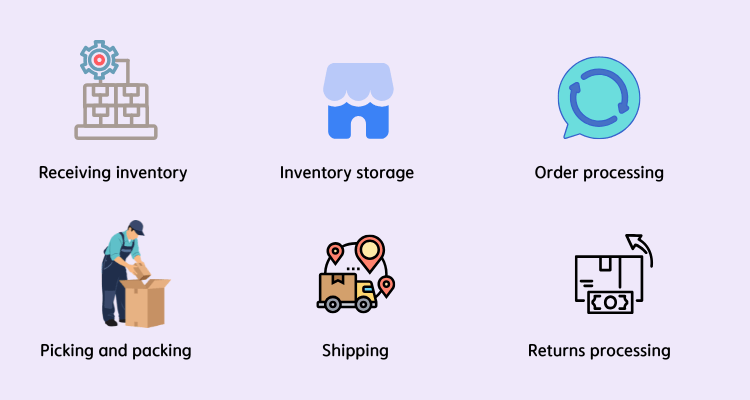
Put simply: fulfillment is everything that happens after the click. A typical fulfillment workflow covers:
- Receiving inventory
- Storing products
- Processing orders
- Picking and packing items
- Shipping packages
- Managing returns
For e-commerce businesses, getting fulfillment right has a direct ripple effect - on how fast orders arrive, how happy customers are, how lean your costs stay, and whether shoppers come back for more.
Order fulfillment vs logistics vs shipping
These three terms are often used interchangeably, but they are not exactly the same thing. See this table:
| Term | Meaning |
|---|---|
| Order fulfillment | The entire process of handling customer orders from purchase to delivery. |
| Logistics | The broader management of transportation, warehousing, and supply chain operations. |
| Shipping | The specific step of transporting products to customers. |
Think of it this way: shipping is one part of shipping fulfillment service, while fulfillment itself is one part of the larger logistics system.
For example, a business might use a logistics provider to manage warehouses and transportation, while a fulfillment center handles packing and sending individual e-commerce orders.
2. The order fulfillment process: step by step
Fulfillment looks a little different from one business to the next, but most e-commerce operations move through the same core stages.
1️⃣Receiving inventory
The process begins when inventory arrives from manufacturers or suppliers.
Products are counted, inspected, and entered into the inventory management system before being stored in the warehouse. Accurate inventory tracking at this stage is important because mistakes here often lead to overselling later.
2️⃣Inventory storage
Once products are checked in, they're organized and shelved by SKU, category, size, or how often they move. (Some have the 3PL logistics option) into your bottom line, it slows down picking, drives up labor costs, and increases the chance of shipping the wrong item.
Most modern fulfillment operations use barcode systems and warehouse management software to keep stock levels accurate in real time.
3️⃣Order processing
When a customer places an order, the e-commerce platform sends the order details to the warehouse or fulfillment provider. At this stage, the system verifies:
- Payment confirmation
- Product availability
- Shipping information
- Fraud checks if necessary
Automated order processing helps reduce delays and minimizes manual work.
4️⃣Picking and packing
Warehouse staff then pick the ordered items from storage shelves.
After picking, products are packed securely using suitable packaging materials. Some brands also include custom packaging, thank-you cards, or promotional inserts to improve the customer experience.
5️⃣Shipping and Delivery
After packing, orders are handed over to shipping carriers or local delivery services. Customers usually receive:
- Shipping confirmation emails
- Tracking numbers
- Delivery updates
Fast and transparent shipping has become a standard expectation in e-commerce, especially with the rise of next-day and two-day delivery services.
6️⃣Returns Management
Order fulfillment doesn't always end at delivery.
Customers may request returns, refunds, or exchanges for damaged, incorrect, or unwanted products. Managing returns efficiently - also called reverse logistics - is an important part of maintaining customer trust.
Have you got the whole order fulfillment workflow?
3. How to improve your order fulfillment strategy
Better order fulfillment isn't just about speed; it's about building a reliable experience for customers without letting costs spiral.
Use inventory management software
Real-time tracking keeps stock levels accurate and prevents overselling. The right system automatically syncs inventory across your store, marketplaces, and warehouses — no manual updates needed.
Automate order processing
Automation reduces human error and keeps orders moving. Routing, tracking updates, and inventory syncing can all run in the background once you have the right tools in place.
Optimize warehouse operations
Better shelf organization, barcode scanning, and smarter picking routes can go a long way. Small changes add up fast, especially as order volume grows.
Work with reliable fulfillment partners
Your carrier's performance is your customer's experience. Regularly compare delivery times, rates, and tracking reliability across providers instead of sticking with just one.
Manual fulfillment has a ceiling. Platforms like Flowpallet bring supplier product sourcing, optional inventory management, white-labelling choices, and order fulfillment into one place, so you're not juggling disconnected systems as you scale. Its whole automated process is worth trying~
For growing brands, a flexible fulfillment strategy is often what separates steady growth from operational gridlock.
Conclusion
Order fulfillment plays a major role in e-commerce success. From inventory management to shipping and returns, every step impacts customer satisfaction and business efficiency.
Whether you handle fulfillment yourself or work with a 3PL provider, having a reliable process helps reduce errors, improve delivery speed, and support long-term growth.
As e-commerce continues to evolve, businesses that invest in smarter and more flexible fulfillment strategies will be better prepared to meet rising customer expectations and scale successfully.
