'/%3e%3cpath%20d='M59.9558%200H51.6287C51.6287%200%2045.5566%2034.1414%2045.7996%2039.9704C48.4659%20103.923%20122.41%2090.4886%20159.049%2075.7773L159.882%2071.6137C72.4464%20100.759%2053.2939%2059.9557%2054.1268%2039.9704C54.7163%2025.8265%2059.9558%200%2059.9558%200Z'%20fill='url(%23paint1_linear_658_5274)'/%3e%3cpath%20d='M180.7%2050.7959L180.845%2049.8037C184.282%2054.4129%20189.53%2057.458%20195.688%2057.458C206.726%2057.458%20217.339%2046.0121%20217.339%2034.9746C217.339%2023.9371%20211.722%2015.8223%20200.685%2015.8223C195.356%2015.8223%20189.544%2018.1027%20184.957%2021.7031L185.696%2016.6543H177.369L168.209%2075.7773H176.536L180.7%2050.7959ZM194.023%2049.9629C183.198%2049.1302%20183.198%2041.6353%20183.198%2037.4717C183.198%2028.3123%20190.455%2023.3157%20197.354%2023.3154C204.252%2023.3154%20208.18%2027.6155%20208.18%2034.9736C208.18%2044.1334%20200.922%2049.9627%20194.023%2049.9629Z'%20fill='%23FBFBFB'/%3e%3cpath%20d='M221.503%2050.7954C226.722%2063.8433%20244.819%2055.7917%20248.982%2050.7954C247.65%2056.7908%20255.088%2057.1796%20258.974%2056.6245L259.807%2049.1304C258.697%2049.1304%20256.476%2048.6308%20256.476%2046.6323C256.476%2044.1342%20260.451%2031.2297%20258.974%2025.814C253.978%207.49469%20228.164%2015.8221%20225.666%2024.9819L231.495%2028.312C242.32%2016.6545%20253.146%2024.9814%20249.815%2031.6431C239.823%2029.1449%20214.842%2034.1413%20221.503%2050.7954ZM248.982%2038.3052C250.648%2045.7997%20233.994%2056.6248%20229.83%2046.6323C227.054%2039.9706%20241.488%2037.4725%20248.982%2038.3052Z'%20fill='%23FBFBFB'/%3e%3cdefs%3e%3clinearGradient%20id='paint0_linear_658_5274'%20x1='333.92'%20y1='70.601'%20x2='188.194'%20y2='70.601'%20gradientUnits='userSpaceOnUse'%3e%3cstop%20stop-color='%23EB5455'/%3e%3cstop%20offset='0.0001'%20stop-color='%23EF733E'/%3e%3cstop%20offset='1'%20stop-color='%23FFD461'/%3e%3c/linearGradient%3e%3clinearGradient%20id='paint1_linear_658_5274'%20x1='139.897'%20y1='83.2717'%20x2='53.2939'%20y2='3.33085'%20gradientUnits='userSpaceOnUse'%3e%3cstop%20stop-color='%23FFD461'/%3e%3cstop%20offset='0.9999'%20stop-color='%23EF733E'/%3e%3c/linearGradient%3e%3c/defs%3e%3c/svg%3e)


Private Labeling VS White Labeling: Which Is Better?
FlowpalletAurora ShawJul. 30, 2026

Creating a brand is easier than ever. Today, you can launch your own products without owning a factory or handling complex manufacturing. Two common paths that make this possible are private label and white label.
At first glance, the two models appear almost the same: both let sellers put their own brand name on products made by third-party manufacturers. The real differences show up in customization, cost, control, and long-term growth potential.
Choosing between private label and white label depends on your business goals. If you want to create a unique product and build a strong brand, private labeling may be the better option. If you want to launch quickly with less investment, white labeling can be a smarter starting point. In this guide, we’ll break down the differences between them.
1. What is private label?
Private label is when a manufacturer makes products exclusively for one company and sells them under that company’s brand.
Unlike reselling generic items, private label sellers control the product itself. You can customize ingredients, materials, design, packaging, size, or features to match your customers’ needs.
For example, a skincare brand can develop a unique serum with its own formula, bottle design, and branded packaging. The factory produces it, but the brand owns the customer experience.
Common private label categories:
- Skincare and beauty
- Supplements
- Clothing and accessories
- Home and lifestyle
- Pet products
- Food and beverages
How private label works
- Find a profitable product: Research customer needs and market gaps.
- Pick a reliable manufacturer: Choose a supplier that can meet your quality and customization requirements.
- Customize the product: Adjust formulas, materials, features, design, or packaging.
- Build your brand: Add your logo, brand story, and marketing strategy.
- Launch and sell: Use your own sales channels to attract and retain customers.
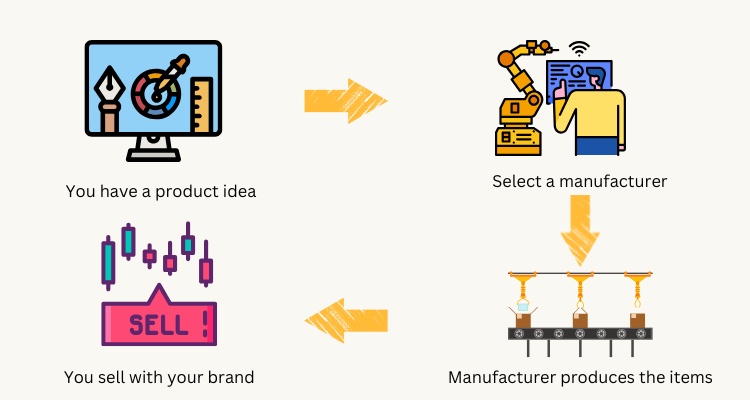
Private labeling needs more upfront investment and planning, but it gives you greater control and stronger differentiation.
2. What is white label?
White label is when a manufacturer makes a ready‑made product that multiple businesses can buy and sell under their own brand names.
The product is already developed. Sellers usually only customize branding—logo, packaging, labels—rather than changing the product itself.
For example, a manufacturer might produce a standard skincare cream and sell it to several companies. Each company adds its own logo and packaging, then markets it as its own product.
Common white label categories:
- Cosmetics
- Electronics accessories
- Basic clothing
- Software solutions
- Health products
- Household items
How white labeling works
- Pick an existing product: Choose something that fits your target market.
- Customize the branding: Add your logo, packaging, and brand details.
- Order from the supplier: The supplier handles manufacturing and fulfillment.
- Sell under your brand: Focus on marketing, customer acquisition, and brand growth.
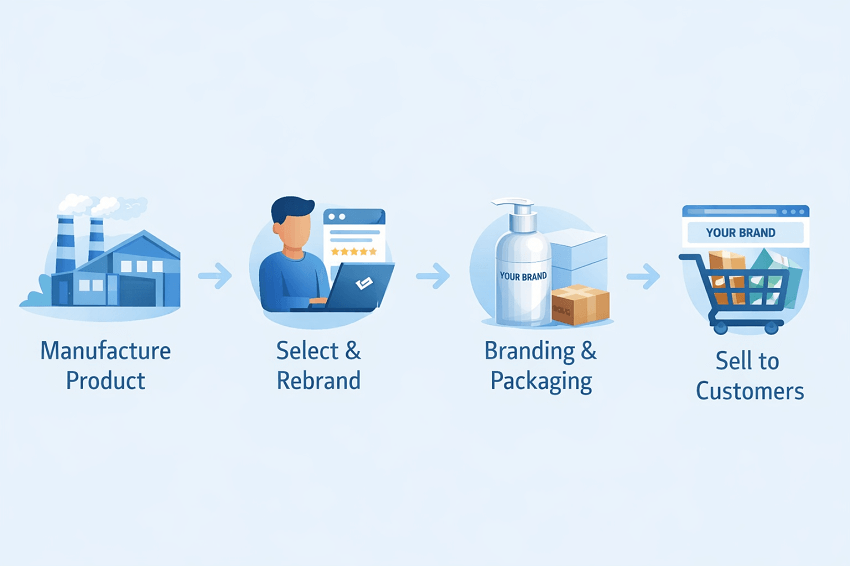
White labeling is popular with beginners because it lets you launch quickly without spending months developing a new product.
3. Private label vs white label: Main differences
Although private label and white label share similarities, there are several important differences.
| Factor | Private Label | White Label |
|---|---|---|
| Product customization | High customization options | Limited customization |
| Product uniqueness | More unique products | Same product may be sold by multiple brands |
| Development time | Longer | Faster |
| Startup cost | Higher | Lower |
| Minimum order quantity (MOQ) | Usually higher | Usually lower |
| Brand differentiation | Stronger | More challenging |
| Product control | Higher control over quality and features | Less control over product changes |
| Best for | Long-term brand building | Quick product launches |
The biggest difference is product ownership and customization.
Private labeling allows you to create something closer to your own product. White labeling focuses more on branding an existing product and bringing it to market quickly.
4. Private label vs white label for dropshipping
Both models work with dropshipping, but they support different strategies.
White label dropshipping
White label dropshipping is ideal for beginners who want to test products and launch fast. You pick ready‑made items from suppliers, add your branding, and start selling without developing a new product.
Key advantages:
- Lower startup costs
- Faster launches
- Minimal product development
- Easier product testing
For example, a new seller can choose an existing product, customize the packaging or label, and sell under their own brand to validate demand before investing more.
Because similar products may be sold by others, strong branding, marketing, and customer experience are essential to stand out.
Private label dropshipping
Private label dropshipping suits businesses focused on building a long‑term brand. Instead of standard items, you work with suppliers to customize products - features, materials, packaging, design, or other brand elements - to match your market.
Key advantages:
- More unique products
- Stronger brand identity
- Higher customer loyalty
- Greater control over quality and positioning
The trade‑off is more planning, supplier coordination, sampling, and upfront investment than white labeling.
For dropshippers aiming beyond short‑term trends and wanting a recognizable brand, private labeling is a powerful growth strategy.
🔑Choosing the right supplier
Finding the right supplier is critical in private label dropshipping. A reliable sourcing and fulfillment partner can simplify everything - from locating manufacturers to managing customization and shipping. Flowpallet helps e-commerce sellers with product sourcing, private label and white label solutions, custom packaging, and fulfillment, so you can turn ideas into branded products while it handles the logistics.
5. Final thoughts
Pick based on your budget, timeline, and goals.
Choose private label if you:
- Want a unique brand and product
- Have a clear product vision
- Can invest more time and money
- Need tight control over quality
- Plan for long‑term growth
Choose white label if you:
- Need a fast launch
- Have a limited budget
- Want to test an idea first
- Prefer to focus on marketing and sales
- Are new to e-commerce
Good luck to you if you can succeed in building your own brand~
