'/%3e%3cpath%20d='M59.9558%200H51.6287C51.6287%200%2045.5566%2034.1414%2045.7996%2039.9704C48.4659%20103.923%20122.41%2090.4886%20159.049%2075.7773L159.882%2071.6137C72.4464%20100.759%2053.2939%2059.9557%2054.1268%2039.9704C54.7163%2025.8265%2059.9558%200%2059.9558%200Z'%20fill='url(%23paint1_linear_658_5274)'/%3e%3cpath%20d='M180.7%2050.7959L180.845%2049.8037C184.282%2054.4129%20189.53%2057.458%20195.688%2057.458C206.726%2057.458%20217.339%2046.0121%20217.339%2034.9746C217.339%2023.9371%20211.722%2015.8223%20200.685%2015.8223C195.356%2015.8223%20189.544%2018.1027%20184.957%2021.7031L185.696%2016.6543H177.369L168.209%2075.7773H176.536L180.7%2050.7959ZM194.023%2049.9629C183.198%2049.1302%20183.198%2041.6353%20183.198%2037.4717C183.198%2028.3123%20190.455%2023.3157%20197.354%2023.3154C204.252%2023.3154%20208.18%2027.6155%20208.18%2034.9736C208.18%2044.1334%20200.922%2049.9627%20194.023%2049.9629Z'%20fill='%23FBFBFB'/%3e%3cpath%20d='M221.503%2050.7954C226.722%2063.8433%20244.819%2055.7917%20248.982%2050.7954C247.65%2056.7908%20255.088%2057.1796%20258.974%2056.6245L259.807%2049.1304C258.697%2049.1304%20256.476%2048.6308%20256.476%2046.6323C256.476%2044.1342%20260.451%2031.2297%20258.974%2025.814C253.978%207.49469%20228.164%2015.8221%20225.666%2024.9819L231.495%2028.312C242.32%2016.6545%20253.146%2024.9814%20249.815%2031.6431C239.823%2029.1449%20214.842%2034.1413%20221.503%2050.7954ZM248.982%2038.3052C250.648%2045.7997%20233.994%2056.6248%20229.83%2046.6323C227.054%2039.9706%20241.488%2037.4725%20248.982%2038.3052Z'%20fill='%23FBFBFB'/%3e%3cdefs%3e%3clinearGradient%20id='paint0_linear_658_5274'%20x1='333.92'%20y1='70.601'%20x2='188.194'%20y2='70.601'%20gradientUnits='userSpaceOnUse'%3e%3cstop%20stop-color='%23EB5455'/%3e%3cstop%20offset='0.0001'%20stop-color='%23EF733E'/%3e%3cstop%20offset='1'%20stop-color='%23FFD461'/%3e%3c/linearGradient%3e%3clinearGradient%20id='paint1_linear_658_5274'%20x1='139.897'%20y1='83.2717'%20x2='53.2939'%20y2='3.33085'%20gradientUnits='userSpaceOnUse'%3e%3cstop%20stop-color='%23FFD461'/%3e%3cstop%20offset='0.9999'%20stop-color='%23EF733E'/%3e%3c/linearGradient%3e%3c/defs%3e%3c/svg%3e)


Understand Dropshipping Definition: How to Succeed?
FlowpalletAurora ShawAug. 31, 2026

Dropshipping has become one of the most talked-about business models in e-commerce, especially among beginners who want to start selling without major upfront investment.
But despite its popularity, many people still misunderstand what dropshipping actually is, how it works, and what it takes to succeed with it. This guide breaks everything down clearly so you know exactly about dropshipping definition—and how to use it to build a profitable online business.
1. What is dropshipping & how does dropshipping work?
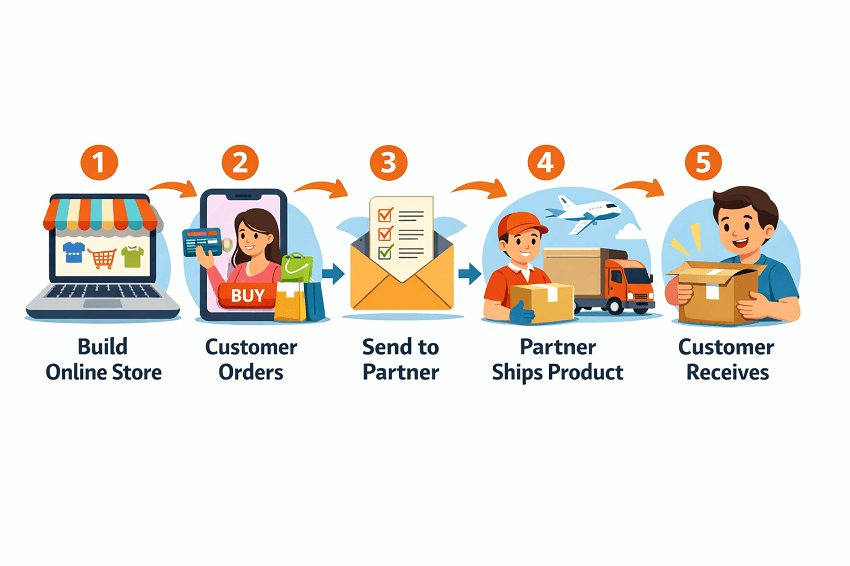
Dropshipping is an online retail model where you sell products without holding inventory. Instead of stocking items yourself, you work with third-party suppliers who store the goods and ship them directly to your customers. How does dropshipping work?
The process involves three distinct roles:
- The supplier: Produces or warehouses the inventory and manages fulfillment (packing and shipping).
- The retailer (dropshipper): Markets and sells the products online without handling stock, as they never physically possess the goods.
- The customer: Places an order with the retailer and receives the shipment directly from the supplier.
In simple terms, you sell the product, and the supplier handles the rest. You act as the middle point between the customer and the supplier, making a profit from the price difference.
2. What is dropshipping's function?
Another part of the definition of dropshipping is the core function: Let online retailers run a store without managing physical inventory. Instead of purchasing stock upfront or handling storage, you rely on suppliers to keep products, prepare orders, and ship items directly to customers.
In practice, its function can be summarized into three key roles:
Inventory outsourcing:
Dropshipping removes the burden of warehousing, stock management, and upfront product investment.
Fulfillment automation:
Suppliers handle packaging and shipping, allowing retailers to focus on marketing, product selection, and customer service.
Risk reduction:
Because you only pay for goods after a customer places an order, dropshipping minimizes financial risk and makes it easier to test new product ideas.
By understanding its function, you can see why dropshipping has become a popular entry point for new e-commerce entrepreneurs—it simplifies operations while keeping overhead costs low.
3. What are the pros and cons of dropshipping?
Before choosing dropshipping as your business model, it's important to understand both sides of it. See the table here:
| Pros | Cons |
|---|---|
| Low startup cost: No warehouse, no bulk inventory required. | Shipping delays: Multiple suppliers may mean inconsistent delivery times. |
| Lower margins: Competition can drive prices down. | Flexible and scalable: Add or remove products without risk. |
| Easy to launch: Quick store setup and wide product variety. | Limited control: Quality, packaging, and stock levels depend on the supplier. |
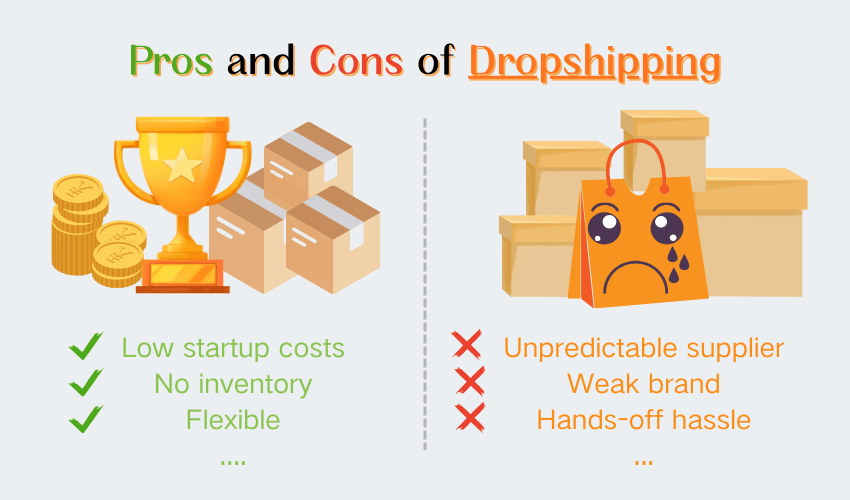
Understanding these pros and cons of dropshipping helps you decide whether the model matches your business goals and risk tolerance.
4. A secret to successful dropshipping
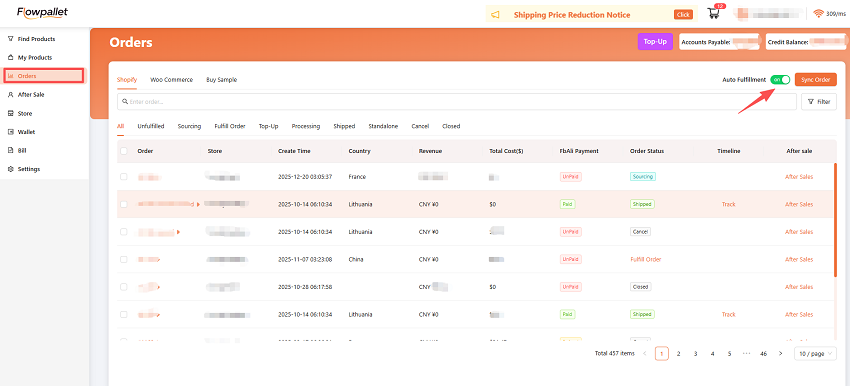
After knowing the main dropshipping definition, you may wonder how to start a dropshipping business or how to make it. The biggest secret to dropshipping success is choosing a platform that reduces manual work—especially order fulfillment and supplier management. This is where tools like Flowpallet can make a real difference.
Flowpallet helps you:
- Streamline product sourcing
- Syncs your orders,
- Auto fulfill order processing
- Track information in real time
- Own Print-on-demand service, 3PL logistics, and so on
When you automate the repetitive parts of dropshipping, you can scale faster, reduce errors, and maintain a better customer experience.
5. Bottom line
Dropshipping offers a simple, low-risk way to start selling online, but understanding what it is, how it functions, and its advantages and drawbacks is essential before diving in.
With the right tools, reliable suppliers, and a clear strategy like Flowpallet, dropshipping can become a flexible and scalable business model that fits both beginners and experienced sellers.
