'/%3e%3cpath%20d='M59.9558%200H51.6287C51.6287%200%2045.5566%2034.1414%2045.7996%2039.9704C48.4659%20103.923%20122.41%2090.4886%20159.049%2075.7773L159.882%2071.6137C72.4464%20100.759%2053.2939%2059.9557%2054.1268%2039.9704C54.7163%2025.8265%2059.9558%200%2059.9558%200Z'%20fill='url(%23paint1_linear_658_5274)'/%3e%3cpath%20d='M180.7%2050.7959L180.845%2049.8037C184.282%2054.4129%20189.53%2057.458%20195.688%2057.458C206.726%2057.458%20217.339%2046.0121%20217.339%2034.9746C217.339%2023.9371%20211.722%2015.8223%20200.685%2015.8223C195.356%2015.8223%20189.544%2018.1027%20184.957%2021.7031L185.696%2016.6543H177.369L168.209%2075.7773H176.536L180.7%2050.7959ZM194.023%2049.9629C183.198%2049.1302%20183.198%2041.6353%20183.198%2037.4717C183.198%2028.3123%20190.455%2023.3157%20197.354%2023.3154C204.252%2023.3154%20208.18%2027.6155%20208.18%2034.9736C208.18%2044.1334%20200.922%2049.9627%20194.023%2049.9629Z'%20fill='%23FBFBFB'/%3e%3cpath%20d='M221.503%2050.7954C226.722%2063.8433%20244.819%2055.7917%20248.982%2050.7954C247.65%2056.7908%20255.088%2057.1796%20258.974%2056.6245L259.807%2049.1304C258.697%2049.1304%20256.476%2048.6308%20256.476%2046.6323C256.476%2044.1342%20260.451%2031.2297%20258.974%2025.814C253.978%207.49469%20228.164%2015.8221%20225.666%2024.9819L231.495%2028.312C242.32%2016.6545%20253.146%2024.9814%20249.815%2031.6431C239.823%2029.1449%20214.842%2034.1413%20221.503%2050.7954ZM248.982%2038.3052C250.648%2045.7997%20233.994%2056.6248%20229.83%2046.6323C227.054%2039.9706%20241.488%2037.4725%20248.982%2038.3052Z'%20fill='%23FBFBFB'/%3e%3cdefs%3e%3clinearGradient%20id='paint0_linear_658_5274'%20x1='333.92'%20y1='70.601'%20x2='188.194'%20y2='70.601'%20gradientUnits='userSpaceOnUse'%3e%3cstop%20stop-color='%23EB5455'/%3e%3cstop%20offset='0.0001'%20stop-color='%23EF733E'/%3e%3cstop%20offset='1'%20stop-color='%23FFD461'/%3e%3c/linearGradient%3e%3clinearGradient%20id='paint1_linear_658_5274'%20x1='139.897'%20y1='83.2717'%20x2='53.2939'%20y2='3.33085'%20gradientUnits='userSpaceOnUse'%3e%3cstop%20stop-color='%23FFD461'/%3e%3cstop%20offset='0.9999'%20stop-color='%23EF733E'/%3e%3c/linearGradient%3e%3c/defs%3e%3c/svg%3e)


What Is Dropshipping and How Does Dropshipping Work?
FlowpalletAurora ShawJun. 12, 2026

Dropshipping has become one of the most popular ways to start an online business, especially for beginners who want to sell products without holding inventory. But while the idea sounds simple, many people still ask the same question: how does dropshipping work?
In this guide, we'll break down the process of starting a dropshipping business step by step, explain the key players involved, and look at the real pros and cons so you can decide whether this business model fits your goals.
1. What is dropshipping?
Maybe you will ask: What is dropshipping? Dropshipping is an eCommerce fulfillment model where you sell products online without stocking them yourself. In this model, your dropshipping partner manages all warehouse and shipping logistics, packing, and sending products directly to your buyers.
Your role as the seller is to:
- Build and market an online store
- Set product prices and manage branding
- Handle customer service
2. How dropshipping works step by step
Understanding how dropshipping works is easiest when you break it down into clear, practical steps.
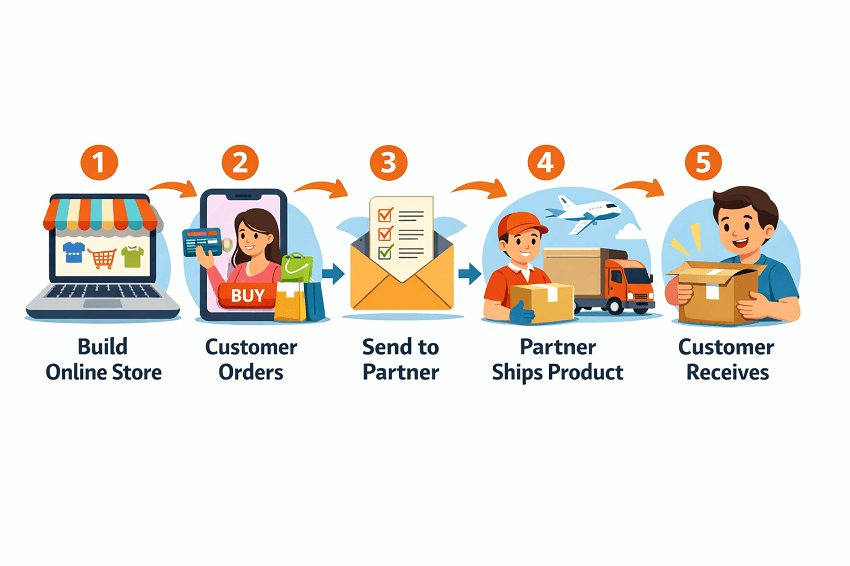
Step 1: You build an online store
The first step is creating an online store using platforms like Shopify, WooCommerce, or BigCommerce. You choose a niche, add product listings, write descriptions, and set your prices.
At this stage, you don't need to buy any inventory. Your store acts as the front end, while dropshipping suppliers handle fulfillment in the background. Learn more about how to choose the right e-commerce platform.
Step 2: Customer places an order in your online store
When a customer visits your store and places an order, they pay the retail price you've set. The payment goes directly to you, and you keep the difference between the selling price and the dropshipping supplier's cost as profit.
From the customer's perspective, they are buying directly from your brand.
Step 3: Order details are sent to the partner
Once the order is placed, the product and shipping details are forwarded to your dropshipping supplier. This can be done manually, but most sellers prefer automation platforms or apps to save time and avoid mistakes.
Platforms that offer auto-order syncing, such as Flowpallet, can automatically push orders to suppliers with just one click—or no clicks at all.
Step 4: Partner prepares and ships the product
The dropshipping supplier picks the product from their warehouse, packages it, and ships it directly to the customer. You never touch the product. Good suppliers also offer:
- Quality checks
- Neutral or branded packaging
- Tracking numbers
This step is critical, as shipping speed and product quality directly affect customer satisfaction.
Step 5: The customer receives the order
The customer receives the product at their doorstep. If there are any issues—such as delivery delays or returns—you handle customer communication while coordinating with the supplier when needed.
A smooth fulfillment process at this stage increases customer satisfaction and repeat purchases.
3. Maybe you need: Dropshipping suppliers and tools
Running a successful dropshipping business depends heavily on the tools and partners you choose.
(1) Dropshipping suppliers: Reliable suppliers are essential. Look for partners that offer consistent quality, stable pricing, and fast shipping.
(2) Automation tools: This is where platforms like Flowpallet stand out. Instead of juggling multiple suppliers and manual processes. And the 5 steps can be 3 steps with Flowpallet: You build a store and connect it to Flowpallet > It auto processes and fulfills the order > Customer receives the order.
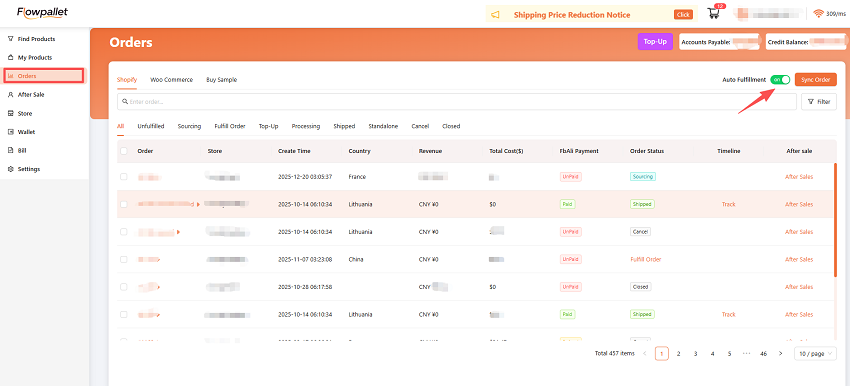
By reducing various tasks, Flowpallet allows sellers to focus more on marketing, brand building, and scaling—rather than daily operations.
4. Advantages and disadvantages of dropshipping
Here is a table summarizing the main pros and cons of dropshipping. You can refer to:
| Advantages | Disadvantages |
|---|---|
| Low startup cost: No need to buy inventory upfront | Lower profit margins: Competition can drive prices down |
| Low risk: You only purchase products after a sale is made | Shipping and packaging depend on suppliers |
| Flexible location: Manage your business from anywhere | Customer service pressure: You're responsible for issues you don't directly control |
| Wide product selection: Easy to switch products | Supplier reliability matters |
Final thoughts
So, how does dropshipping work? At its core, it's about acting as the bridge between customers and suppliers—without handling inventory yourself. When done right, and supported by the right tools and partners, dropshipping can be a scalable and sustainable business model.
Choosing reliable suppliers and automation platforms like Flowpallet can make the entire process smoother, more efficient, and far easier to manage as your store grows.
