'/%3e%3cpath%20d='M59.9558%200H51.6287C51.6287%200%2045.5566%2034.1414%2045.7996%2039.9704C48.4659%20103.923%20122.41%2090.4886%20159.049%2075.7773L159.882%2071.6137C72.4464%20100.759%2053.2939%2059.9557%2054.1268%2039.9704C54.7163%2025.8265%2059.9558%200%2059.9558%200Z'%20fill='url(%23paint1_linear_658_5274)'/%3e%3cpath%20d='M180.7%2050.7959L180.845%2049.8037C184.282%2054.4129%20189.53%2057.458%20195.688%2057.458C206.726%2057.458%20217.339%2046.0121%20217.339%2034.9746C217.339%2023.9371%20211.722%2015.8223%20200.685%2015.8223C195.356%2015.8223%20189.544%2018.1027%20184.957%2021.7031L185.696%2016.6543H177.369L168.209%2075.7773H176.536L180.7%2050.7959ZM194.023%2049.9629C183.198%2049.1302%20183.198%2041.6353%20183.198%2037.4717C183.198%2028.3123%20190.455%2023.3157%20197.354%2023.3154C204.252%2023.3154%20208.18%2027.6155%20208.18%2034.9736C208.18%2044.1334%20200.922%2049.9627%20194.023%2049.9629Z'%20fill='%23FBFBFB'/%3e%3cpath%20d='M221.503%2050.7954C226.722%2063.8433%20244.819%2055.7917%20248.982%2050.7954C247.65%2056.7908%20255.088%2057.1796%20258.974%2056.6245L259.807%2049.1304C258.697%2049.1304%20256.476%2048.6308%20256.476%2046.6323C256.476%2044.1342%20260.451%2031.2297%20258.974%2025.814C253.978%207.49469%20228.164%2015.8221%20225.666%2024.9819L231.495%2028.312C242.32%2016.6545%20253.146%2024.9814%20249.815%2031.6431C239.823%2029.1449%20214.842%2034.1413%20221.503%2050.7954ZM248.982%2038.3052C250.648%2045.7997%20233.994%2056.6248%20229.83%2046.6323C227.054%2039.9706%20241.488%2037.4725%20248.982%2038.3052Z'%20fill='%23FBFBFB'/%3e%3cdefs%3e%3clinearGradient%20id='paint0_linear_658_5274'%20x1='333.92'%20y1='70.601'%20x2='188.194'%20y2='70.601'%20gradientUnits='userSpaceOnUse'%3e%3cstop%20stop-color='%23EB5455'/%3e%3cstop%20offset='0.0001'%20stop-color='%23EF733E'/%3e%3cstop%20offset='1'%20stop-color='%23FFD461'/%3e%3c/linearGradient%3e%3clinearGradient%20id='paint1_linear_658_5274'%20x1='139.897'%20y1='83.2717'%20x2='53.2939'%20y2='3.33085'%20gradientUnits='userSpaceOnUse'%3e%3cstop%20stop-color='%23FFD461'/%3e%3cstop%20offset='0.9999'%20stop-color='%23EF733E'/%3e%3c/linearGradient%3e%3c/defs%3e%3c/svg%3e)


What Does Drop Shipping Mean? Pros and Cons
FlowpalletAurora ShawJul. 27, 2026

Dropshipping is one of the simplest ways to start an online business. Unlike a traditional retail store, you do not need to buy inventory in advance or rent a warehouse. Instead, you list products online, and when a customer places an order, your supplier stores, packs, and ships the item directly to them.
This business model has become popular with entrepreneurs, students, and side hustlers because it requires relatively low upfront investment. Still, many beginners ask the same question: what does dropshipping actually mean?
In this guide, we'll explain dropshipping in simple terms, show you how it works, outline its pros and cons, and help you decide whether it is the right business model for you.
1. What does drop ship mean?
What does drop ship mean? Drop shipping, or dropshipping, is an order fulfillment method where an online store sells products without keeping them in stock. Instead of buying inventory in advance, the store owner sends customer orders to a third-party supplier. The supplier then packs and ships the product directly to the customer.
This means the seller never has to handle the product physically.
A simple example
Imagine you run an online store that sells reusable water bottles. Here's how the process works:
- A customer visits your website and buys a bottle for $30.
- You receive the order and payment.
- You buy the same bottle from your supplier for $18.
- The supplier ships the bottle directly to your customer.
- You keep the difference as profit, before expenses.
In most cases, the customer never realizes that another company fulfilled the order. For the workflow process: Customer → Places an order → Your online store → Sends order to supplier → Supplier → Packs & Ships product → Customer receives package.
Dropshipping vs. Traditional Retail
| Dropshipping | Traditional Retail |
|---|---|
| No inventory required | Inventory must be purchased in advance |
| Low startup costs | Higher upfront investment |
| Supplier handles shipping | Business ships products itself |
| Easy to test new products | Unsold inventory creates risk |
| Less control over fulfillment | Full control over stock and shipping |
Because sellers don't invest heavily in inventory, dropshipping has become one of the most popular ways to launch an e-commerce business.
2. Pros and cons of dropshipping
Dropshipping offers many advantages for beginners, but it also comes with some challenges. Understanding both sides can help you decide whether this business model fits your goals.
| Pros of Dropshipping | Cons of Dropshipping |
|---|---|
| Low startup costs | Lower profit margins |
| No inventory management | Less control over shipping |
| Wide product selection | Product quality risks |
| Easy to test new products | Supplier reliability issues |
| Flexible business model | Customer service responsibility |
3. How to start dropshipping
Now that you understand what dropshipping is and how it works, the next step is getting started. The good news is that starting a dropshipping business is easier than ever. With the right tools and reliable suppliers, you can launch an online store without buying inventory upfront.
1️⃣Choose a profitable niche
Your niche is the type of products you sell. A good niche can make marketing easier and help your store stand out. Look for products that solve a problem, have steady demand, offer good margins, and appeal to a clear audience.
Popular dropshipping niches include home and kitchen, pet supplies, beauty products, fitness accessories, and phone gadgets.
2️⃣Find a reliable supplier
Your supplier plays a major role in product quality, shipping speed, and fulfillment. Before choosing one, check their product quality, shipping times, communication, reviews, return policy, and inventory stability. Ordering samples is always a smart idea.
3️⃣Build your online store
Next, create your ecommerce store. Many beginners use Shopify or WooCommerce because they are easy to set up and support dropshipping integrations.
Make sure your store has a clean design, clear product descriptions, strong product images, secure payment options, and clear shipping and return policies.
4️⃣Import products
Once your store is ready, add products from your supplier. Start with a smaller collection that matches your niche instead of listing too many random items. This keeps your store focused and easier to browse.
5️⃣Promote your store
Even great products need traffic. Common marketing channels include SEO, TikTok and Instagram content, Facebook and Google Ads, influencer marketing, and email marketing.
6️⃣Handle orders and support
Once orders start coming in, focus on a smooth customer experience. Process orders quickly, share tracking details, reply to questions promptly, and handle returns professionally.
7️⃣Simplify dropshipping with Flowpallet
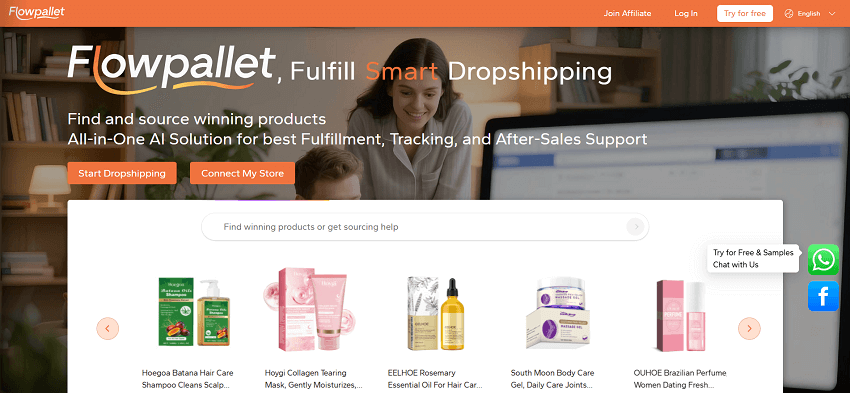
Managing a dropshipping business is much easier with the right fulfillment partner. Flowpallet is an all-in-one dropshipping and sourcing platform that helps e-commerce sellers manage sourcing, fulfillment, and shipping in one place.
With Flowpallet, you can source products from trusted suppliers, automate order fulfillment, inspect quality before shipping, create custom packaging, sync with Shopify and WooCommerce, and enjoy fast global shipping.
4. Conclusion
So, what does drop ship mean? Simply put, it is a retail fulfillment model where you sell products without holding inventory. Dropshipping is still one of the easiest ways to start an e-commerce business because it requires low upfront investment and lets you test products with less risk.
Long-term success depends on choosing reliable suppliers, offering good service, and building trust with customers. Good luck~
